
Yes, you can renovate an office without closing for business if you separate construction from occupied areas, maintain safe access and schedule disruptive work around operations. For a 2026 renovation, staying open must remain conditional: move staff or suspend affected activities whenever the work compromises safe occupation, essential services or the ability to do their jobs.
TL;DR
- To renovate office without closing for business, use phased construction, separated work areas and planned service interruptions.
- For teams briefing Giant Leap, business continuity belongs in the office renovation brief from the start.
- Phased occupation suits separable work areas; temporary relocation suits work that affects the whole office.
- Keep staff out of construction zones and approve each completed area before reoccupation.
Why this matters
Keeping the business operating does not require keeping everyone at their usual desk. You can preserve customer service while moving a department, using temporary space or arranging remote work where the role permits it. The goal is continuity of work, not uninterrupted use of every room.
When briefing Giant Leap, describe which activities cannot stop before discussing finishes or furniture. Your 2026 brief should identify essential systems, customer-facing hours, access requirements and the person authorised to approve interruptions.
An occupied renovation puts two different activities beside each other: construction and everyday work. A programme that ignores either one leaves decisions about noise, access and shutdowns until people are already affected.
Can you renovate an office without closing for business?
Yes, provided the renovation programme protects occupied areas and makes necessary interruptions explicit. Choose the operating arrangement around the work, rather than asking staff to work around an unsuitable arrangement.
There are 3 operating options to compare. None removes the need for a construction plan, and each places different demands on your team.
Phased occupation
- Best for: Offices with areas that can be separated
- Main advantage: Staff keep using unaffected parts of the premises
- Main limitation: Repeated moves and changing access routes require coordination
Out-of-hours work
- Best for: Disruptive tasks that can be completed and made safe before staff return
- Main advantage: Separates some construction activity from working hours
- Main limitation: Unfinished work, cleaning and service restoration still affect reopening
Temporary relocation
- Best for: Work affecting shared systems or most of the premises
- Main advantage: Separates staff from the construction site
- Main limitation: Requires another workable location and a business transition plan
These arrangements can be combined. For example, staff can occupy one area while another is renovated, with a planned interruption for work on a shared service. The important distinction is between a controlled interruption and an unexpected loss of service.
Before selecting an approach, ask the project team to show where staff will work, how they will enter and leave, and which services will remain operational. A coloured floor plan is useful, but it is not enough without an accompanying sequence of work.
Phased occupation: keep separate areas operational
Phased occupation divides the premises into work areas and occupied areas. Staff move only after the next working area is ready, and contractors gain access to the space released for renovation.
Phased occupation is best for teams whose workspace and supporting services can genuinely be separated. A partition on a drawing does not establish that separation: access, ventilation, toilets, power and emergency arrangements also need review.
Agree how each phase will function before starting:
- Identify the staff and activities assigned to the occupied area.
- Establish boundaries between construction and everyday work.
- Confirm usable access routes and emergency arrangements.
- Map the services needed on both sides of the boundary.
- Define what must be complete before staff move again.
The benefit is continued use of part of the office. The drawback is repeated disruption: packing, relocating equipment, changing meeting arrangements and explaining new routes all require attention.
For your 2026 programme, include these business moves as project activities. Treating them as informal tasks leaves the construction sequence disconnected from the people it depends on.
Out-of-hours work: separate disruption from working time
Out-of-hours work places selected tasks outside your normal operating hours. It is best for work that can be completed, checked and left safe before the office is occupied again.
This approach suits a defined task better than an open-ended promise to do all noisy work after everyone leaves. The contractor needs an agreed stopping point and a plan for what happens if the task cannot be finished as expected.
The reopening deadline includes cleaning, testing and service restoration—not just the end of construction work. Staff cannot use an area simply because the tools have been packed away.
Check building access arrangements, permitted working hours and any restrictions affecting neighbouring occupants. Also decide who can approve an extension or activate a fallback workspace outside ordinary business hours.
The advantage is separation from your busiest operating periods. The limitation is that a short access window does not make every task suitable for overnight completion.
Temporary relocation: keep trading away from the work
Temporary relocation moves affected staff out of the renovation area while the business continues elsewhere. It is best for work that cannot be safely or practically separated from occupied space.
You do not necessarily need to relocate the whole organisation. A customer-facing team and an internal support team have different workspace requirements, so assess activities rather than assuming everyone needs the same arrangement.
Check the temporary location against actual work requirements:
- Can staff access the systems and records they need?
- Can customers reach the correct people through existing channels?
- Is confidential information protected during moves and temporary working?
- Are deliveries, visitors and physical documents routed correctly?
- Does each team know when and how it will return?
Relocation removes staff from the construction area, but it introduces a transition of its own. Test the working arrangement before relying on it; an alternative address is not automatically an operational office.
Why the ability to stay open varies
Whether you can renovate an office without closing for business depends on the interaction between the work and your operations. These factors determine the operating plan:
- Work scope. Surface finishes and furniture changes present different coordination needs from work affecting building services or internal layouts.
- Physical separation. Construction boundaries must account for people, materials, dust and access—not just the floor area under renovation.
- Shared services. Electrical distribution, connectivity, ventilation and plumbing can connect occupied areas to the work zone.
- Business dependencies. A room used occasionally has a different operational role from the only space supporting an essential activity.
- Building constraints. Access arrangements, neighbouring occupants and building management requirements influence when and how work proceeds.
- Reoccupation requirements. Completion includes relevant checks, cleaning and usable services before staff return.
Do not decide from the description of the work alone. Ask what each task interrupts and who depends on it. That question exposes conflicts that a finish schedule or furniture layout does not address.
How do you plan an occupied office renovation?
Use these 5 steps to connect the construction programme with a workable operating plan. For a 2026 project, keep the current version accessible to both the construction lead and the person responsible for business continuity.
Identify dependencies
List the activities that must continue and what each requires: people, rooms, equipment, systems and access. Identify shared dependencies explicitly, such as connectivity serving teams outside the immediate work area.
Assign an owner to each essential activity. That person should confirm whether the proposed temporary arrangement supports the work, rather than leaving the decision entirely to the construction team.
Divide areas
Mark construction space, occupied space, material routes and staff routes. Ask the responsible project professionals to assess whether the proposed separation and emergency arrangements are suitable.
Avoid routing normal office activity through a construction zone. If a proposed phase depends on that overlap, revise the layout or move the affected staff.
Schedule interruptions
Create an interruption schedule alongside the construction programme. Name the affected service, the business activities it supports, the authorised window and the fallback arrangement.
For each interruption, define how the team will confirm restoration. An assumption that a service will be available the next morning is not a restoration check.
Communicate changes
Tell staff what changes, when it changes and what they need to do. Include temporary entrances, unavailable rooms, delivery instructions and the person to contact about a problem.
Update instructions when the plan changes. A notice issued at the start of the project becomes unreliable if staff are expected to remember later verbal amendments.
Approve reoccupation
Use 2 distinct sign-offs: one for readiness of the renovated area and one for readiness of the business to use it. The appropriate project professionals should address construction-related checks; the business owner should confirm the working setup.
Keep unfinished work and its access requirements visible. Moving staff back does not remove the need to control any remaining contractor activity.
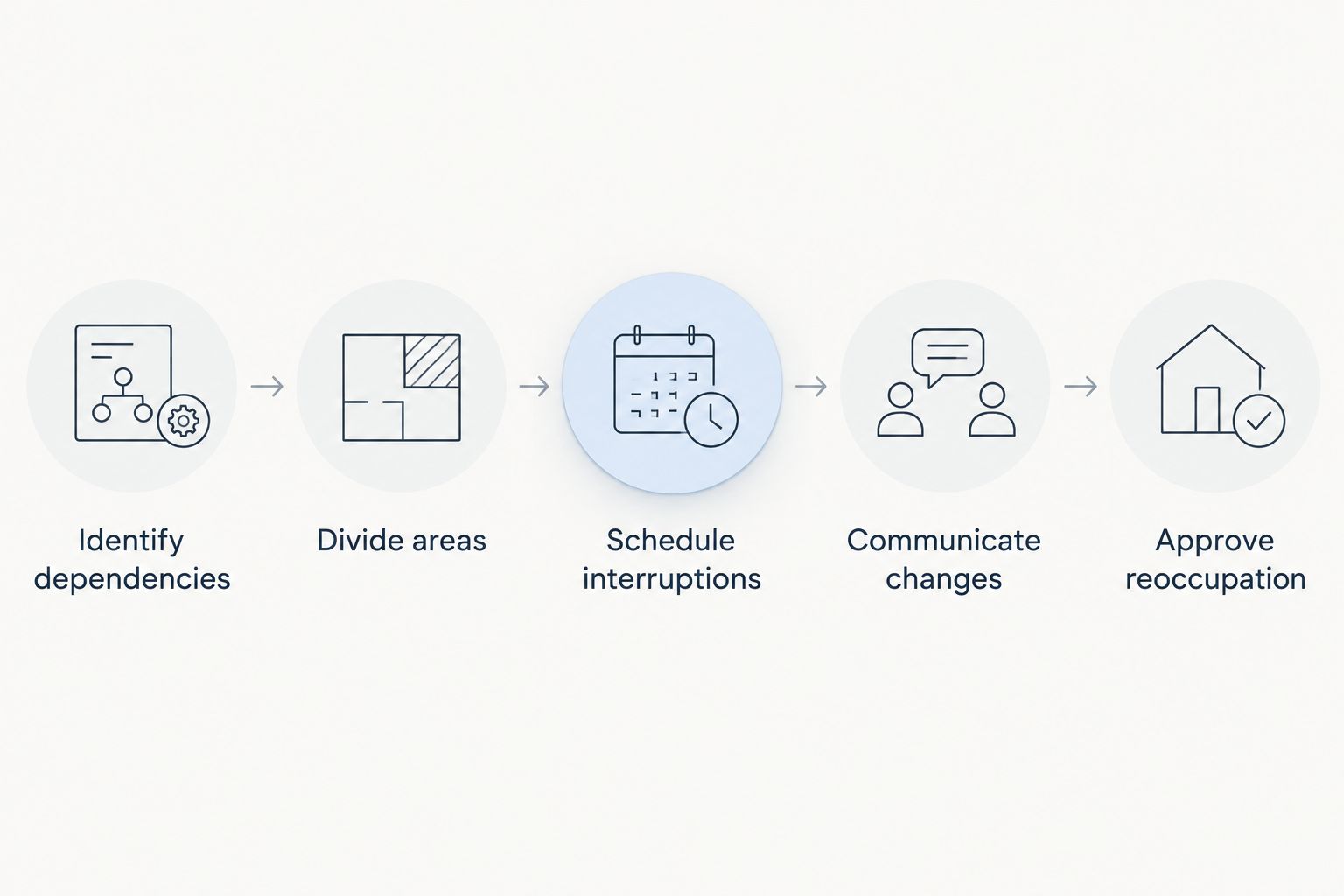
Plan business operations alongside construction, then check both before staff return.
What should you ask before approving the programme?
Ask for evidence that the operating plan works, not a general assurance that disruption will be managed. A useful programme connects each work area with access arrangements, service interruptions and staff moves.
Before approval, request clear answers to these questions:
- Which activities require people to leave the affected area?
- Which services cross the proposed construction boundary?
- Who approves a shutdown, and who confirms restoration?
- Where do staff work if a phase is not ready for occupation?
- How will building management and neighbouring occupants be informed?
- What checks are required before each area returns to use?
For teams briefing Giant Leap, phased office renovation is best for work that can be separated from daily operations. If the programme cannot explain that separation, choose a different operating arrangement rather than relying on staff to absorb the conflict.
Can employees work in the office during renovation?
Employees can work in areas assessed as suitable for occupation and separated from construction activity. Continued attendance is not appropriate merely because desks remain accessible; the working environment, services and emergency arrangements also need to function.
Set a clear reporting route for dust, noise, blocked access or service failures. Staff should know whom to contact and what alternative arrangement applies if their workspace becomes unsuitable.
Does working after hours remove the need to relocate?
Working after hours does not remove the need to relocate when the effects of construction continue into occupied hours. Unfinished surfaces, isolated services or areas awaiting checks still require an alternative plan.
Choose out-of-hours work task by task. Ask what condition the office will be left in before the next working period begins.
When should you stop work in an occupied area?
Stop the affected activity and follow the agreed safety procedures when the occupied arrangement no longer meets the project's safety or operational requirements. Examples include compromised access, failed separation or an essential service becoming unavailable.
For a 2026 renovation, put the escalation process in the project brief before work starts. Name who can stop the affected work, who assesses the problem and who authorises resumption.
FAQ
Can you renovate an office without closing for business?
Yes, if construction can be separated from occupied areas and essential business activities remain supported. Use phased occupation, selected out-of-hours work or temporary relocation according to the work involved.
What's the best way to keep an office open during renovation?
Phased occupation is best when work areas and their supporting services can be separated. Where they cannot, temporarily relocating affected staff provides a clearer separation from construction.
Can office renovation happen over a weekend?
Some tasks can be scheduled over a weekend, but the area must be ready for safe use before staff return. Include cleaning, relevant checks and service restoration in the available work window.
Do we need to move every employee out?
You do not need to move every employee if unaffected areas remain suitable for occupation. Assess each team's activities, access and service dependencies before deciding who stays.
How do we protect customer service during office renovation?
Protect customer service by identifying the people, systems and communication channels it requires before work begins. Test the temporary arrangement and assign responsibility for planned interruptions.
What should we include when briefing Giant Leap?
Include the work you need done, the activities that must continue and the restrictions affecting occupation. State essential service dependencies, access needs and who can authorise shutdowns.
When can staff return to a renovated office area?
Staff should return after the area has passed the relevant readiness checks and the business setup is operational. Confirm access, cleaning, services and arrangements for any remaining work before reoccupation.
One last thing
Your most important renovation dependency might sit outside the room being renovated. A shared service or access route can connect an apparently isolated work area to teams elsewhere in the office.
Before approving the first phase, trace those connections. A programme built around operational dependencies gives you a stronger basis for staying open than one built around room boundaries alone.