
Office furniture cost in South Africa needs a specification-based quote, not a single national average. Your total depends on the furniture you select, how many workspaces you need and what the supplier includes; for a 2026 budget, check delivery, assembly, installation and VAT separately before comparing offers.
TL;DR
- Office furniture cost South Africa comparisons need matching specifications, quantities and installation scope—not just matching item names.
- Compare desks, chairs and storage separately, then calculate the complete delivered and installed total.
- If Giant Leap is on your shortlist, use the same written furniture brief for every enquiry.
- Keep furniture purchasing separate from electrical work, cabling and other office fit-out costs.
Why this matters
An office furniture budget is useful only when it describes what your team will actually receive. A quote for desks and chairs is not directly comparable with one that also includes storage, meeting furniture and installation.
If Giant Leap is on your shortlist, start with a written schedule of rooms, users and required items. Send that same schedule to each business you approach so differences in the responses are visible rather than buried in assumptions.
For your 2026 purchasing decision, separate three questions: what you need, what each quote includes and what you can defer. That keeps a lower initial total from becoming the deciding factor when the underlying scope is different.
How much does office furniture cost in South Africa?
The amount you should budget is the total for your specified furniture package, plus the separately identified costs needed to put it into use. Start with an itemised schedule rather than a single allowance per employee: reception seating, shared storage and meeting furniture do not necessarily increase in step with headcount.
Use the following breakdown to structure your budget. These are purchasing categories, not assumptions about what any particular supplier includes.
Workstation desks
- What to specify: Quantity, dimensions, layout and cable access
- What to check in the quote: Tops, frames, screens and accessories included
Task chairs
- What to specify: Intended use, adjustment requirements and upholstery
- What to check in the quote: Exact model and supplied configuration
Storage
- What to specify: Filing needs, dimensions and locking requirements
- What to check in the quote: Doors, drawers, shelves and locks included
Meeting furniture
- What to specify: Room layout, table dimensions and seating
- What to check in the quote: Table, chairs and cable-management components
Reception furniture
- What to specify: Seating arrangement, desk requirements and available space
- What to check in the quote: Individual pieces versus a complete arrangement
Delivery and installation
- What to specify: Destination, access conditions and assembly requirements
- What to check in the quote: Transport, carrying, assembly and packaging removal
Tax
- What to specify: Whether quoted amounts include VAT
- What to check in the quote: Consistent tax treatment across every comparison
In South Africa, the standard VAT rate is 15%. Check whether VAT applies to the transaction and whether it is already included before adding anything to the quoted total; do not add it twice.
Keep optional items in a separate column. You should be able to remove an accessory or postpone a room without asking someone to rebuild an unclear lump-sum quotation.
Build the total from quantities and scope
Calculate each furniture line as the agreed quantity multiplied by its quoted unit amount. Then add the applicable delivery, assembly, installation and tax amounts without counting anything already included.
Keep an exclusions list alongside that total. An exclusion is not automatically a problem, but it becomes your responsibility to arrange and budget for it if the office needs it.
The result should answer a practical question: what is the complete amount required to make this furniture ready for its intended use? That is the figure to compare—not an isolated desk or chair amount.
Individual workstation: specify the complete setup
A workstation budget should describe a usable desk-and-chair arrangement, not simply two product names. Record the desk dimensions, intended equipment, chair adjustments and any required storage or cable-management components.
Best for: defining what each regular desk user needs. The advantage is a repeatable specification that makes omissions easier to identify; the limitation is that a workstation allowance does not cover shared rooms or reception areas.
Check the distinction between essential and optional accessories. A monitor arm, desk screen or pedestal should appear as a separate line unless the quote explicitly includes it in the workstation configuration.
Avoid selecting desk dimensions without checking the layout. Furniture that fits individually can still create an unsuitable arrangement when doors, circulation and neighbouring workstations are considered.
Shared spaces: budget by room, not by employee
Meeting rooms, reception areas and shared storage need their own schedules. List the purpose of each room before choosing its furniture, then check how the proposed pieces work together.
Best for: spaces used by different people throughout the working day. The advantage is that room-based planning captures shared needs; the limitation is that these requirements are easily missed in a simple per-person calculation.
For meeting rooms, specify the table arrangement, seating and any furniture-related cable access. Keep audiovisual equipment and electrical installation separate unless the quotation expressly includes them.
For reception, distinguish furniture requirements from decorative choices. Decide what the space must support before approving finishes or adding pieces that were not in the original brief.
Reuse, partial replacement or a complete package?
Compare purchasing approaches before comparing individual products. Keeping suitable furniture, replacing selected items and buying a complete package create different scopes, so their totals alone do not tell you which approach serves your office.
Reuse existing furniture
- Best for: Items that still meet the required brief
- Advantage: Retains usable items and reduces the purchasing list
- Limitation: Existing dimensions or condition can constrain the layout
- Decision check: Inspect condition and confirm fit
Replace selected items
- Best for: Offices with clearly identified gaps
- Advantage: Directs purchasing towards specific needs
- Limitation: Mixed furniture can complicate consistency and compatibility
- Decision check: Check old and new pieces together
Specify a complete package
- Best for: A new layout or a full furniture replacement
- Advantage: Allows the furniture to be planned as one package
- Limitation: Expands the purchasing and installation scope
- Decision check: Require an itemised room-by-room schedule
Replace furniture because it fails a defined requirement, not simply because another item is newer. Equally, keeping an unsuitable chair or desk solely to shorten the purchasing list leaves the underlying problem unresolved.
For a 2026 refresh, record what stays before requesting replacement quotes. Otherwise, different respondents can make different assumptions about how much of the office they are being asked to furnish.
Why office furniture costs vary
The specification drives the comparison. These factors belong in your brief because changing them changes what you are asking a supplier to provide.
- Quantity and configuration: Individual desks, shared workstations and room-based furniture packages contain different components. Compare the complete arrangement rather than counting visible surfaces.
- Materials and construction: Ask for the stated top, frame, edge and upholstery specifications. A similar appearance does not establish that two items use the same construction.
- Chair functionality: Record the adjustments and support features you require. Compare those features directly rather than relying on a general description such as ergonomic.
- Dimensions and layout: Desk sizes, storage depth and meeting-table dimensions affect whether the proposed furniture fits your plan. Treat dimensions as requirements, not details to confirm after ordering.
- Accessories and integration: Screens, cable trays, monitor arms and storage inserts can sit outside the main furniture line. Identify which are necessary for your intended setup.
- Delivery and installation scope: Confirm the destination, building access and work required on site. Ask explicitly who handles assembly, positioning and packaging removal.
Do not infer durability, suitability or included services from the total alone. Ask for the specification and the written scope that explain the offer.
How do you get comparable office furniture quotes?
Use a consistent sequence so each response answers the same brief. A detailed enquiry is more useful than asking several businesses to furnish an office without describing its rooms, users or constraints.
- Map the rooms. Record usable dimensions, doors, fixed obstructions and circulation needs. Identify which rooms need furniture and which are outside the project.
- List the users. Separate regular desk users from visitors and shared-space users. Record tasks that affect the furniture specification, such as equipment use or document storage.
- Specify the furniture. Create an item schedule with quantities, dimensions, functions and required accessories. Mark acceptable alternatives clearly rather than leaving substitutions undefined.
- Define the services. State the delivery destination and describe access conditions. Ask respondents to identify assembly, installation and removal work separately.
- Compare the totals. Align quantities, specifications, tax treatment and exclusions before judging the final amounts. Return unclear lines for clarification before approving the order.
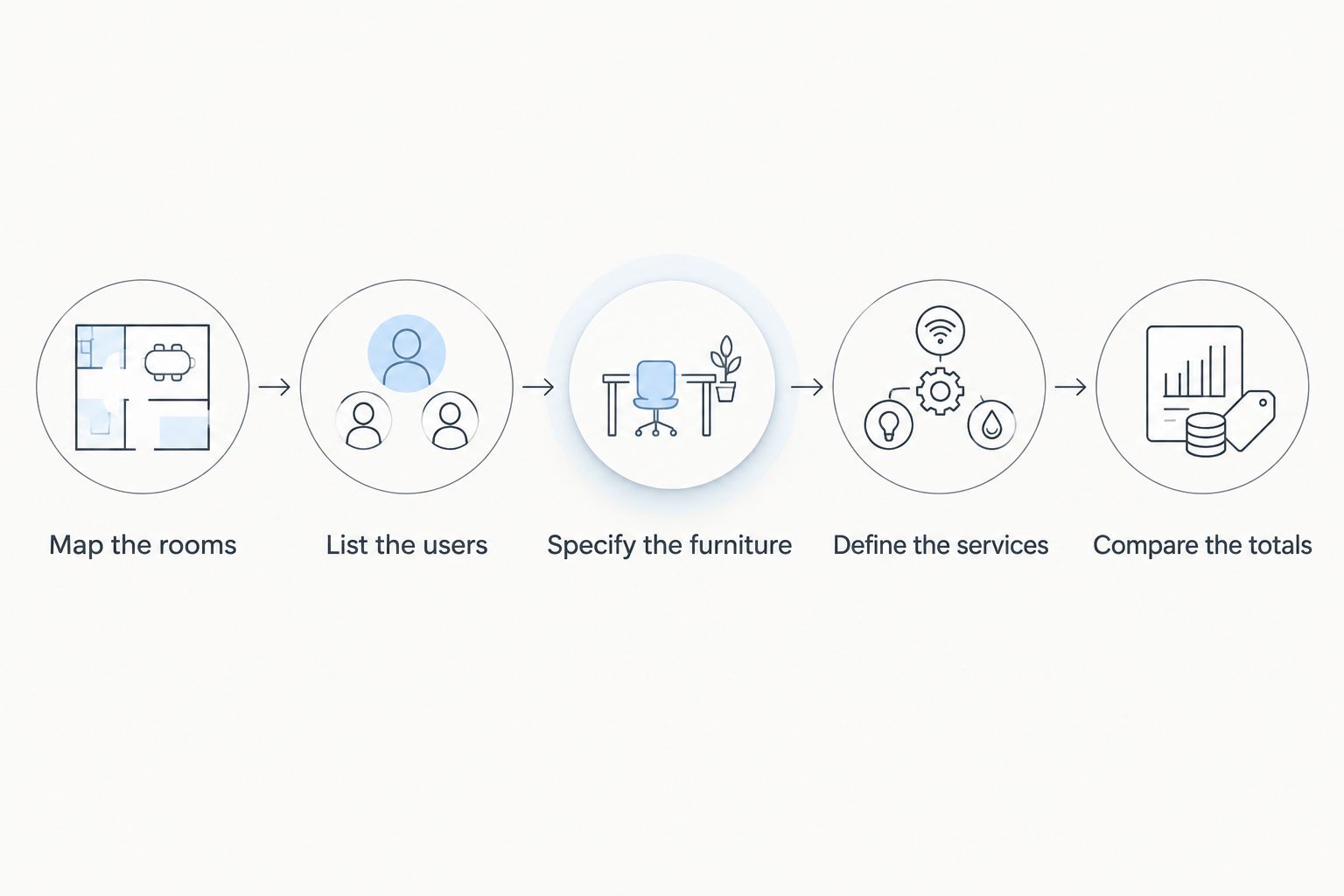
Compare totals only after the furniture and service requirements match.
Keep this schedule as the reference document for your 2026 order. If the layout or quantity changes, update the schedule and request a revised response so the approved scope remains clear.
What should an office furniture quote include?
A useful quotation lets you trace every supplied item back to a requirement. It should identify the proposed furniture clearly enough that you can distinguish the selected configuration from an alternative.
Ask for these details in writing:
- Item descriptions, quantities and dimensions.
- Materials, finishes and upholstery selections where relevant.
- Chair functions and included accessories.
- Delivery destination and the associated service scope.
- Assembly, installation and packaging-removal responsibilities.
- VAT treatment, exclusions and optional items.
- Written warranty terms and any care requirements supplied for the proposed items.
If Giant Leap is among the businesses you approach, use this same checklist rather than changing the brief between enquiries. Consistency makes differences easier to resolve and keeps the comparison focused on your actual requirements.
Do not approve a substitution by appearance alone. Compare its dimensions, functions, materials and included components against the item it replaces, then record the agreed change.
Is it cheaper to buy office furniture as a package?
A package is not automatically the better-value choice. Compare its itemised contents and service scope against the separate items you actually need; an unwanted component still belongs in your purchasing decision.
Packages are useful for reviewing a coordinated proposal, but the limitation is reduced visibility when everything appears under one description. Request a breakdown that lets you identify omissions, alternatives and items you intend to defer.
Should you budget per employee or per room?
Budget per workstation for individual setups and per room for shared areas. Combining both methods gives you a clearer schedule than applying one undifferentiated allowance to everyone in the office.
Keep shared storage, reception and meeting furniture visible. Otherwise, those requirements can disappear into a workstation figure that does not explain what the office will receive.
Does an office furniture budget include a full fit-out?
An office furniture budget covers only the scope expressly listed in the quotation. Do not assume it includes electrical work, data cabling, flooring, partitions or alterations merely because those tasks are needed for the finished workspace.
Separate furniture from building and technology work in your project schedule. Then identify dependencies so the furniture installation is planned around the work that must happen first.
FAQ
How much should I budget for office furniture in South Africa?
Budget from an itemised furniture schedule and the complete quoted delivery and installation scope. Separate individual workstations from shared rooms, then check tax treatment and exclusions before comparing totals.
Does office furniture pricing include VAT in South Africa?
Check the quotation: VAT inclusion must be explicit. South Africa's standard VAT rate is 15%, so confirm whether it applies and whether it is already included before adjusting the total.
What should I include in a workstation furniture budget?
Include the specified desk, chair and any storage or accessories required for that workstation. Record dimensions and chair functions so alternatives can be compared against the same requirements.
Is buying office furniture as a package better than buying separately?
A package is better only when its contents and service scope match your requirements. Request an itemised breakdown so unwanted components and missing essentials remain visible.
Can I keep some furniture and replace the rest?
Keep existing furniture that meets your condition, function and layout requirements. Check how retained and replacement pieces work together before finalising the order.
What should I ask about furniture delivery and assembly?
Ask who handles transport, carrying, assembly, positioning and packaging removal. Give the delivery address and building-access details so the written scope reflects the site.
How do I compare office furniture quotes in 2026?
Compare matching quantities, dimensions, functions and included services before comparing the final totals. Resolve different tax treatments, substitutions and exclusions in writing.
One last thing
The most useful line in your furniture brief can be what you are keeping. A clear retained-furniture list prevents a replacement proposal from expanding beyond the work you intended to do.
Before sending a 2026 enquiry to Giant Leap or another business on your shortlist, walk through the office with your schedule. Mark each item as retain, replace or remove, then check the room layout against those decisions. Your budget should follow that brief—not define it after the fact.