
Yes—acoustic treatment is worth it for an open-plan office when reflected sound makes conversations linger, overlap and distract nearby colleagues. It is not a substitute for sound isolation, so panels alone will not stop speech travelling through an open layout or make confidential conversations private; the decision depends on which noise problem you need to solve.
TL;DR
- Acoustic treatment is worth it for open-plan offices with excessive reverberation, not as a stand-alone privacy solution.
- Absorptive ceilings and wall panels reduce reflections; enclosed rooms address a different problem: sound transfer.
- Match treatment to the noise source, occupied layout and task before choosing finishes.
- Give Giant Leap a problem-led office brief rather than a shopping list of acoustic panels.
Is acoustic treatment worth it for open-plan offices in 2026?
Acoustic treatment is worth specifying when the problem is excessive sound reflection. Sound isolation is the priority when conversations must stay inside a room. An open-plan office can need both, but they are not interchangeable.
Use the comparison below to match the intervention to the complaint. These are different approaches, not competing products with the same job.
Absorptive ceiling treatment
- Best for: Reflections across an open workspace
- Main benefit: Absorbs sound that would otherwise reflect from the ceiling
- Main limitation: Does not create an enclosed acoustic barrier
Absorptive wall panels
- Best for: Reflective walls near work or meeting areas
- Main benefit: Reduces reflections from treated surfaces
- Main limitation: Cannot compensate for every untreated surface or direct sound path
Desk screens
- Best for: Local separation between adjacent workstations
- Main benefit: Interrupts some direct sound paths when correctly positioned
- Main limitation: Sound can travel over and around the screen
Enclosed rooms with suitable sound isolation
- Best for: Calls, meetings and confidential discussions
- Main benefit: Separates sound-producing activities from neighbouring work
- Main limitation: Performance depends on the complete enclosure, including doors and ventilation paths
Zoning and behaviour changes
- Best for: Conflicting activities sharing a workspace
- Main benefit: Moves noisy tasks away from concentration areas
- Main limitation: Requires suitable space and consistent use
For a 2026 office brief, start with the complaint and its location. A request to reduce echo needs a different response from a request to stop colleagues hearing sales calls.
Why this matters
An office can sound quieter without becoming private. Reducing reflected sound can improve the listening environment, while nearby speech remains audible because there is still a direct path between desks.
When discussing your requirements with Giant Leap, describe where noise starts, who it affects and what those people need to do. That creates a clearer brief than asking for acoustic panels without identifying the problem.
The distinction matters during refurbishment too. A visually enclosed meeting room is not automatically acoustically isolated, and an attractive fabric surface is not automatically an effective sound absorber.
What counts as a worthwhile result?
Define the result around the task: clearer speech inside a meeting room, less lingering sound in a collaboration area, or fewer interruptions at concentration desks. Those outcomes require different checks.
Avoid a blanket promise to make the office silent. The useful question is whether the proposed change addresses the noise that prevents people doing their work.
Absorptive ceilings: best for overhead reflections
An absorptive ceiling addresses sound reflecting from a large overhead surface. This makes ceiling treatment relevant where speech and activity spread through a hard, reflective workspace.
The benefit is broad surface coverage without using workstation floor space. The limitation is equally important: ceiling absorption does not prevent a nearby colleague’s voice reaching you directly.
For a 2026 refurbishment, coordinate the acoustic proposal with lighting, ventilation, fire-safety requirements and access to building services. A treatment layout must work with the ceiling, not just look convincing on a finish schedule.
Ask for absorption performance information for the proposed material and installation. Material thickness, mounting conditions and the air space behind an absorber affect its performance; appearance alone does not establish suitability.
Wall panels: best for reflective wall surfaces
Absorptive wall panels address reflections from the surfaces they cover. They are relevant where hard walls contribute to a lively sound field, including meeting spaces and collaboration areas.
Their advantage is targeted placement. Their limitation is coverage: a small decorative arrangement does not demonstrate that the room’s acoustic needs have been met.
Identify the reflective surfaces and listening positions before deciding where panels belong. The design should explain why each treated area matters, rather than distributing panels only to create visual symmetry.
Do not judge a panel solely by its fabric covering. Request evidence for the complete acoustic construction, including the backing and installation method.
Desk screens: best for local separation
Desk screens are relevant when adjacent workstations need some separation without a full enclosure. Their acoustic effect depends on their height, position, construction and relationship to the speaker and listener.
A screen can interrupt a direct sound path, but an open office leaves other paths available. Sound can pass over the top, around the ends and through reflections from surrounding surfaces.
Treat desk screens as part of a layout, not a replacement for quiet rooms. They are a poor answer to a requirement for confidential calls because they do not form a complete enclosure.
Check the occupied arrangement before specifying screens. Sightlines, circulation, accessibility and collaboration needs still matter; solving one problem should not create another.
Enclosed rooms: best for calls and confidential discussions
Enclosed rooms address separation between activities. They are the relevant option when people need to speak without disturbing nearby desks or when conversations require privacy.
Their strength is the physical boundary. Their weakness is that a boundary only works as well as its complete construction: doors, junctions, glazing and building-service paths all need attention.
Absorption inside a room and isolation around that room perform different jobs. Internal treatment controls reflections; the enclosure controls sound transfer between spaces.
For a 2026 project, write both requirements into the room brief. Specifying wall panels inside a meeting room does not establish whether people outside it will hear the conversation.
Why the value of acoustic treatment varies
The same treatment can be useful in one workspace and poorly matched to another. These factors determine whether it addresses the actual complaint:
- Noise source: Speech, ventilation noise and equipment noise need different investigations. Absorption does not repair a noisy mechanical system.
- Sound path: Direct speech between nearby desks differs from sound reflected across a room. Treatment must address the relevant path.
- Room surfaces: Hard ceilings, walls and glazing reflect sound. Their location and extent affect where absorption belongs.
- Office layout: Distance, circulation routes and the position of call-heavy teams shape who hears whom.
- Task requirements: Collaboration, concentrated work and confidential conversations need different acoustic conditions.
- Installation details: Coverage, mounting, gaps and junctions influence whether the specified approach performs as intended.
Occupancy matters as well. Assess the workspace when it is being used, because an empty office does not reproduce the speech activity and movement behind the complaint.
How do you decide what your office needs?
Use this sequence before choosing materials. It separates a reflection problem from a source, layout or isolation problem and gives the design team a brief they can answer.
- Map complaints. Mark the workstations and rooms where people report difficulty. Record the task affected, not just a general description such as noisy.
- Identify sources. Note whether the interruption comes from conversations, calls, equipment, circulation or building services.
- Trace sound. Establish whether people hear direct speech, reflected sound, transmission through an enclosure or a combination.
- Match interventions. Connect each complaint to absorption, isolation, relocation, source control or a combination of these approaches.
- Check results. Agree how the same locations and activities will be assessed after installation.
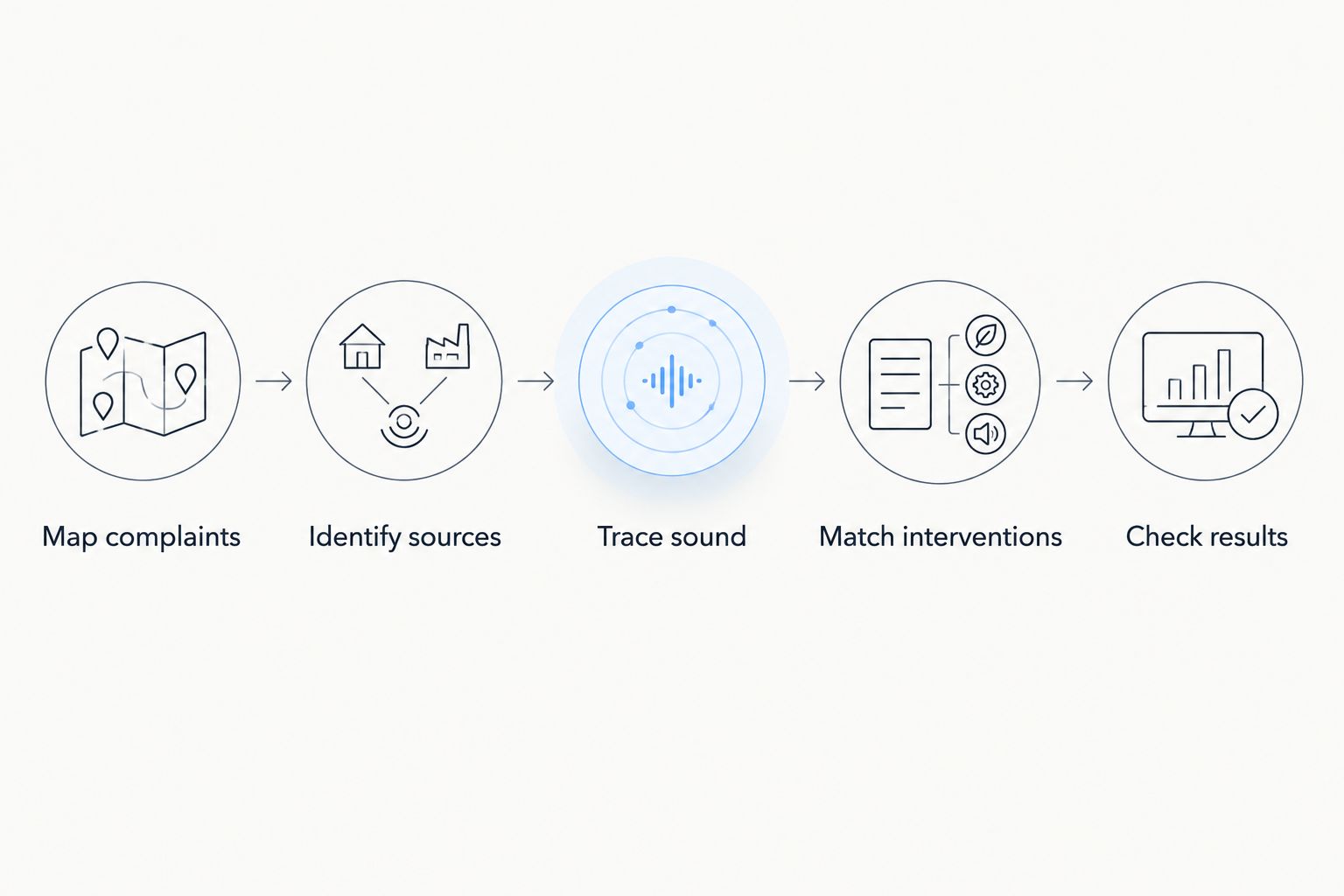
Identify the source and sound path before selecting an acoustic treatment.
A practical observation plan can include 3 listening locations: beside the main noise source, within the affected desk area and inside any room where privacy is expected. These are suggested checkpoints, not a measurement standard or a performance guarantee.
Spend 15 minutes per location recording what interrupts work, then repeat the exercise during a different activity period. This is a briefing exercise; a formal acoustic assessment requires appropriate measurement methods and interpretation.
Keep a 1-page brief containing the complaint, affected task, location and proposed acceptance check. A short, specific brief is more useful than a long list of materials without a defined purpose.
What should an acoustic proposal explain?
A useful proposal connects each intervention to a problem. You should be able to see why a ceiling needs absorption, why a team needs relocation or why a meeting room needs changes to its enclosure.
For your 2026 specification, ask for:
- The noise sources and affected areas the proposal addresses.
- The distinction between absorption and sound isolation in each space.
- Performance information relevant to the proposed materials and mounting.
- Installation details where gaps, junctions or services affect the result.
- A clear method for checking the completed work against the agreed brief.
Give Giant Leap the same problem statement you use to evaluate any proposal. Keep the acceptance criteria consistent so that an attractive presentation does not replace an explanation of how the noise problem will be addressed.
Do not accept quieter as a complete specification. Ask quieter where, during which activity, and assessed by what method.
Will acoustic panels make an open-plan office private?
No—acoustic panels alone do not make an open-plan office private. They absorb reflected sound but do not create a complete barrier between a conversation and surrounding listeners.
Where privacy is required, assess enclosed spaces and their sound-isolation details. Do not use reduced echo as evidence that a discussion cannot be overheard.
Can you improve office acoustics without changing the layout?
Yes, absorption can address reflections without moving every workstation. However, leaving a call-heavy team beside concentration desks preserves a direct source of interruption even after the room becomes less reverberant.
Start with the smallest intervention that addresses the identified problem. Retain the option to change activity locations when surface treatment cannot meet the task requirement.
Is sound masking the same as acoustic treatment?
No—sound masking introduces controlled background sound, whereas absorptive treatment reduces reflected sound. Neither should be described as a substitute for the physical isolation required for confidential spaces.
If sound masking is proposed, ask how it fits the office’s acoustic design and how the system will be commissioned. Adding background sound is not the same as removing a noise source.
FAQ
Is acoustic treatment worth it for an open-plan office?
Yes, acoustic treatment is worth it when excessive reflections contribute to distraction or difficult listening. It does not replace sound isolation where conversations need privacy.
What's the difference between acoustic treatment and soundproofing?
Acoustic treatment controls sound within a space, while soundproofing usually refers to reducing sound transfer between spaces. Specify the actual performance requirement rather than relying on either label alone.
Are ceiling treatments better than wall panels?
Neither is universally better; placement depends on the reflective surfaces and the problem being addressed. Ceiling treatment and wall panels can form parts of the same acoustic design.
Will desk screens stop colleagues hearing my calls?
Desk screens do not guarantee that colleagues cannot hear your calls. Sound can travel over and around them, so private conversations need a different level of separation.
Can acoustic treatment fix a noisy air-conditioning system?
Acoustic treatment does not fix the source of a noisy air-conditioning system. Investigate the equipment and sound-transmission paths before selecting room finishes.
Should office acoustics be assessed when the office is empty?
An empty-office assessment alone does not capture the activity behind occupied-office complaints. Include the relevant working conditions and use appropriate acoustic measurements where required.
What should I ask Giant Leap about my office noise problem?
Ask Giant Leap to discuss the affected tasks, noise sources and locations before discussing finishes. Request a clear distinction between reducing reflections and providing speech privacy.
One last thing
Less echo does not prove greater privacy. A room can sound more controlled inside while people outside still hear the conversation through a poorly isolated door or another transmission path.
Before approving acoustic work, write separate acceptance criteria for listening comfort and privacy wherever both matter. That single distinction prevents a surface-treatment specification from being mistaken for a complete office-noise solution.