
Office greenery is worth the maintenance cost when you want living plants, can match them to the available light, and assign responsibility for their care. For your 2026 decision, include watering, cleaning, replacement and protection of nearby surfaces in the assessment—not just the plants themselves.
TL;DR
- Is office greenery worth the maintenance cost? Yes, when plant selection, placement and care responsibilities fit your office.
- Giant Leap’s recommendation: start with a manageable planting scheme before committing to a larger installation.
- Live plants need care; artificial plants still need cleaning; neither option guarantees better workplace performance.
- Approve office planting only after naming a care owner and agreeing how replacements will be handled.
Is office greenery worth the maintenance cost in 2026?
Yes—if you value the planting itself and can support the work it creates. Do not approve greenery on the assumption that it will repay its upkeep through higher productivity, fewer sick days or better air quality. Those outcomes need evidence specific to the claim, not an attractive planting proposal.
This Giant Leap guide is for office decision-makers who need to separate an appealing idea from a workable care commitment. Compare the following options before choosing a scheme.
Live plants
- Best for: Offices that want living greenery and can provide suitable conditions
- Main advantage: Living foliage and natural variation
- Main limitation: Plant health depends on conditions and care
- Maintenance commitment: Watering, inspection, cleaning and occasional replacement
Artificial plants
- Best for: Spaces where living plants are impractical
- Main advantage: No watering or plant-health care
- Main limitation: Does not provide living greenery; appearance varies by material
- Maintenance commitment: Dusting, cleaning and checks for damage
No planting
- Best for: Offices that do not want an ongoing plant-care task
- Main advantage: Removes plant-related upkeep
- Main limitation: No greenery from plants
- Maintenance commitment: No plant maintenance
None is the automatic winner. A small, well-kept live display is a better choice than an extensive planting scheme that nobody owns; no planting is better than an installation you cannot maintain.
Why this matters
Office planting creates a recurring responsibility. Someone must notice dry soil, falling leaves, standing water, dust and damage—and have permission to act.
The approval question for 2026 is therefore not simply whether plants look good. It is whether the office can support the particular scheme being proposed, including periods when the usual caretaker is absent.
Separate visual preference from measurable business return. You can reasonably choose greenery because you want it in the workplace. That does not establish a financial return, and you should not need an unsupported productivity claim to justify a modest design preference.
Live plants: choose them for living greenery
Best for: offices with suitable light, accessible planting locations and a named care owner. Live plants make sense when living foliage is part of what you want from the space, rather than merely a green shape in a corner.
Their care depends on the plant, container, growing medium and location. A plant beside a window and one deep inside a room do not necessarily receive comparable light, even when both locations look bright to people.
The advantage is straightforward: you get a living element that changes as it grows. The trade-off is equally straightforward: growth, decline and seasonal conditions require observation and adjustment.
Before approving live planting, ask:
- Does each proposed plant suit its actual position?
- Can someone reach the container without moving furniture?
- Is there a practical way to water without spilling onto finishes or equipment?
- Who checks plant health between scheduled visits?
- What happens when a plant becomes unsuitable for its position?
Choose live plants for the experience of living greenery, not as a substitute for ventilation, cleaning or workplace repairs. Keep those building responsibilities separate.
Artificial plants: choose them when watering is impractical
Best for: locations where you want a planted appearance without live-plant care. Artificial plants remove watering and plant-health requirements, which makes them an option where access or growing conditions rule out living plants.
They do not remove maintenance altogether. Leaves, stems, containers and nearby surfaces still collect dust, and an arrangement needs attention when it becomes dirty or damaged.
Appearance also deserves a close inspection. Evaluate a sample from the distance and viewing angle people will actually encounter, rather than relying only on a supplier image.
Ask who will clean the installation and how they will reach it. A high-level artificial display can still create an awkward maintenance task, despite needing no water.
Choose artificial plants when their appearance meets your expectations and the cleaning plan is practical. Do not present them as delivering the same experience as living plants; that is a preference your team should judge directly.
No planting: choose it when upkeep has no owner
Best for: offices that cannot commit to plant care or do not particularly want greenery. Leaving plants out is a valid decision, not a failed design exercise.
The advantage is avoiding plant-specific watering, replacement and cleaning tasks. The limitation is that you do not get the planted appearance or living element you were considering.
Do not install greenery solely because an office feels unfinished. First identify what is missing: an empty corner, an uncomfortable waiting area or a poorly defined boundary between activities. Planting is one possible response, not a diagnosis.
Skip planting when the office has no suitable location, no responsible owner or no clear reason to want it. Revisit the decision when those conditions change.
Why office greenery maintenance varies
There is no useful maintenance judgement without a planting plan. For your 2026 review, compare proposals against the same responsibilities rather than treating every green installation as equivalent.
- Plant selection: Different plants have different light, moisture and care requirements. Selection must fit the location rather than just the desired appearance.
- Placement: Reachable containers are simpler to inspect and clean than installations above furniture or in restricted areas. Check access before installation.
- Scheme size: Every additional container adds another item to inspect, water or clean. A larger scheme needs a care plan that reflects its full extent.
- Containers and surfaces: Water management matters around flooring, joinery and electrical equipment. Clarify how containers handle drainage and how surrounding finishes will be protected.
- Care ownership: Staff care and an external service allocate responsibility differently. Either arrangement needs a named contact, clear tasks and absence cover.
- Replacement expectations: Agree what counts as an unacceptable plant and who approves replacement. Otherwise, a declining plant can remain in place while responsibility is disputed.
Giant Leap’s rule for office greenery is simple: keep it only where you can maintain it. An inaccessible installation does not become practical because its plants are described as low-maintenance.
How to assess a planting proposal before approval
Use this sequence to turn a planting idea into an operating decision. The aim is not to make the brief complicated; it is to make responsibility visible before anyone orders plants.
- Map the locations. Mark the exact positions on the office plan. Check light, access, nearby equipment, circulation and the surfaces beneath each container.
- Define the purpose. State what each location is meant to achieve. A welcoming reception display and a screen between desks need different assessments.
- Assign the care. Name the person or provider responsible for watering, inspection, cleaning and reporting problems. Include cover for absence and office closures.
- Agree the review. Decide how you will judge the scheme after installation. Include plant condition, cleanliness, access and the work required to keep it acceptable.
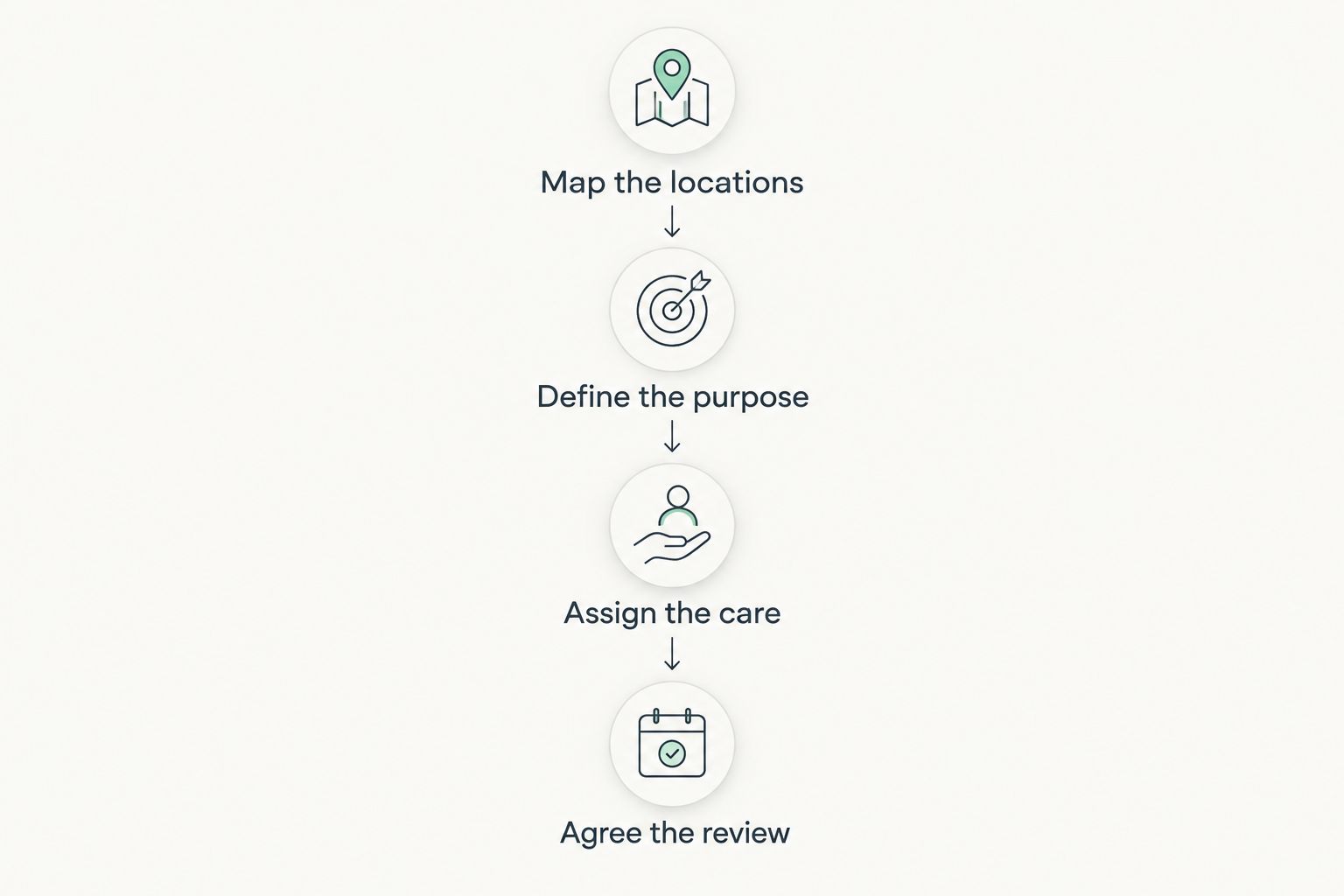
Agree the care responsibilities before approving the planting scheme.
Keep the resulting brief short enough that the person looking after the plants can use it. A detailed proposal is not a substitute for a clear handover.
Start with a limited trial
For a practical 2026 trial, choose 3 planting positions rather than introducing greenery throughout the office at once. Select positions that represent the conditions you actually need to assess, such as a window-adjacent area, an interior location and a shared space.
Appoint 1 care owner and schedule an initial review after 30 days. These are suggested trial parameters, not plant-care standards or a promise that every suitability issue will appear within that period.
Record what happens: missed care, spills, obstructed access, leaf damage, cleaning difficulties and comments from people using the space. Continue observation beyond the initial review before treating the arrangement as settled.
Separate routine care from exceptions
A useful care agreement distinguishes ordinary tasks from problems requiring a decision. Watering and routine inspection belong in the normal schedule; moving an installation or changing an unsuitable plant needs a clear approval route.
Also establish who reports a problem and who resolves it. A receptionist noticing water beneath a container should not have to work out which department owns the planting contract.
What should an office greenery maintenance agreement include?
Specify the tasks, not just a promise to maintain the plants. A proposal should make it possible to understand what is included and which responsibilities remain with your office.
Check the agreement for:
- Watering and checks of the growing medium.
- Removal of fallen or damaged foliage.
- Cleaning of leaves, containers and the immediate planting area.
- Inspection for pests or signs of declining plant health.
- Handling of drainage, spills and standing water.
- Reporting, replacement approval and access arrangements.
If staff will do the work, use the same checklist internally. Informal care still takes time, and assigning it to whoever happens to be nearby does not create reliable ownership.
For your 2026 agreement, clarify office closures and access restrictions before they occur. A schedule that assumes someone is always present leaves a predictable gap during absences.
Can office greenery pay for itself through productivity?
Do not assume that office greenery pays for itself through productivity. A claim about employee performance needs evidence showing what was measured, under which conditions, and whether the result applies to your workplace.
You can assess employee preference without converting it into a financial claim. Ask whether people like the installation, whether it obstructs their work and whether its condition remains acceptable.
If your business case depends on a measurable return, define that test before approval. Do not treat a positive comment about the office as proof of a productivity increase.
Is low-maintenance office greenery maintenance-free?
Low-maintenance office greenery is not maintenance-free. Living plants still need conditions suited to them, while artificial plants still need cleaning and inspection.
Ask what the description excludes. A proposal that requires little watering can still involve difficult access, leaf cleaning, container care or replacement work.
Judge the complete task, not the label. The most manageable scheme is the one your office can consistently look after in its actual location.
FAQ
Is office greenery worth the maintenance cost for a small office?
Office greenery is worth the maintenance cost for a small office when the team wants it and can maintain it reliably. Start with suitable, accessible locations and assign responsibility before expanding the scheme.
Are artificial plants better than real plants in an office?
Artificial plants are better suited to locations where watering or growing conditions make live plants impractical. They still need cleaning, and you should judge their appearance in the actual space.
How often should office plants be watered?
Office plants should be watered according to their species, growing medium and conditions, not a single schedule for every container. Ask for care instructions matched to the plants and their locations.
Should employees look after office plants?
Employees can look after office plants when the responsibility is explicit and they have suitable care instructions. Name an owner and provide cover rather than relying on informal shared responsibility.
Do office plants replace the need for ventilation?
Office plants do not replace the need for ventilation. Assess planting separately from the building’s ventilation, cleaning and indoor-air management responsibilities.
What does Giant Leap recommend checking before approving office greenery?
Giant Leap recommends checking location, purpose, care ownership and review arrangements before approving office greenery. A planting scheme should have a workable maintenance plan, not just an appealing presentation.
What should I check in an office greenery proposal in 2026?
For an office greenery proposal in 2026, check plant suitability, access, routine care, surface protection and replacement responsibility. Make sure the written agreement identifies which tasks remain with your office.
One last thing
Reject any planting position that nobody can safely reach for routine care. Access is easy to overlook in a presentation and difficult to fix after furniture and containers are in place.
Before approving the scheme, ask the proposed caretaker to explain how each position will be watered, inspected and cleaned. That practical walk-through is a stronger acceptance test than the phrase low-maintenance.