
Office renovation is worth it in 2026 when it fixes a defined workplace problem and offers a better practical outcome than repairs, a smaller refurbishment or relocation. The decision must account for disruption, lease conditions and ongoing maintenance—not just the finished appearance.
TL;DR
- Giant Leap’s office renovation verdict: renovate for a defined workplace need, not for appearance alone.
- Is office renovation worth it? Compare the proposed work with repairs, refurbishment and relocation before deciding.
- Confirm lease permissions, operational disruption and the complete scope before approving construction.
- Set measurable acceptance criteria so you can judge whether the finished office solves the original problem.
Is office renovation worth it in 2026?
Yes—when you can identify what is wrong, explain how the proposed work fixes it, and justify keeping the premises. A dated appearance alone does not establish the case for a full renovation. Start with the activities your office needs to support, then choose the smallest intervention that addresses the problem properly.
This Giant Leap office renovation guide is best for teams deciding whether to improve their existing premises before committing to a construction brief.
Targeted repairs
- Best for: Isolated defects in an otherwise suitable office
- Main advantage: Keeps the work focused on a specific fault
- Main drawback: Leaves wider layout problems unchanged
Light refurbishment
- Best for: Worn finishes or furniture in a workable layout
- Main advantage: Updates selected elements without redesigning everything
- Main drawback: Does not resolve unsuitable building infrastructure
Office renovation
- Best for: Recurring problems that require coordinated changes
- Main advantage: Lets you address connected issues in a single brief
- Main drawback: Requires planning for disruption and dependencies
Relocation
- Best for: Premises that no longer fit essential requirements
- Main advantage: Lets you evaluate a different building or location
- Main drawback: Adds a separate search, lease and moving process
These are decision categories, not interchangeable quotations. A repair proposal and a renovation proposal only become comparable when you understand which problems each includes—and which remain unresolved.
Why this matters
Your 2026 renovation decision determines more than what the office looks like. It sets the work you approve, the interruptions your team must manage and the obligations you accept for premises you might not own.
A persuasive design does not answer whether you need the project. Neither does a long list of complaints: several complaints can share a single cause, while a seemingly simple request can involve building services or landlord approval.
Separate the business problem from the proposed building work. If the problem is unclear, the brief is not ready.
Targeted repairs: best for isolated defects
Choose targeted repairs when the office still supports your work and the issue has a clear boundary. Examples include a damaged finish, a faulty fitting or an individual item that needs professional assessment.
The advantage is focus. You can define the defect and the expected result without reopening the entire office layout.
The limitation is equally clear: repairing a component does not change how the surrounding space functions. Replacing a damaged door, for example, does not establish whether the room behind it is suitable for its intended use.
Ask whether the complaint would remain after the repair. If the answer is yes, keep the repair in the maintenance plan and assess the wider workplace issue separately.
Recommendation: approve repairs for identifiable defects; do not present them as a solution to an unrelated layout problem.
Light refurbishment: best for a workable layout
A light refurbishment fits an office whose arrangement still works but whose selected finishes, fittings or furniture need attention. Define exactly what stays before deciding what changes.
The advantage is a narrower brief. Retaining suitable elements lets you concentrate the project on the parts that no longer meet your requirements.
The drawback is its boundary. New finishes cannot establish adequate ventilation, make an unsuitable room accessible or resolve every acoustic problem. Those issues require assessment of the conditions involved.
For your 2026 brief, distinguish appearance from function. If a request combines both, specify the functional requirement first and assess the finish against it.
Recommendation: choose light refurbishment when the existing layout works and the proposed changes have a clearly limited purpose.
Office renovation: best for connected workplace problems
A coordinated renovation deserves consideration when changes depend on one another. Altering room arrangements, for example, requires checking how those arrangements relate to lighting, power, ventilation, circulation and other building requirements.
The advantage is coordination. You can assess the connected requirements before treating each as a separate purchase or instruction.
The drawback is complexity. A change to the brief can affect other work, so the project needs clear responsibilities, approval points and a process for handling variations.
Do not assume that a larger project is a better project. Require each proposed element to answer a specific need, and distinguish necessary work from optional preferences.
Recommendation: consider renovation when the problems are connected and a coordinated scope addresses them more clearly than separate interventions.
Relocation: best for premises that cannot meet essential needs
Include relocation in the comparison when the existing premises cannot satisfy requirements you consider essential. Test location, usable space, access, building constraints and lease conditions before investing in a detailed renovation proposal.
The advantage is choice: you can evaluate premises with different characteristics rather than treating the current building as fixed. The drawback is a separate decision process involving the proposed lease, fit-out requirements, move and operational transition.
Relocation is not automatically the better answer to an awkward office. Equally, renovation cannot change the address or remove every building constraint.
Recommendation: compare relocation when an essential requirement sits outside the renovation scope. Do not spend the design process trying to solve a problem that the premises cannot accommodate.
Why office renovation value varies
There is no universal answer to whether office renovation is worth it. The decision depends on the relationship between your workplace needs, the proposed intervention and the premises.
- Problem fit: The scope must address the issue you actually experience. A visual refresh and a room-layout change answer different questions.
- Lease position: Check permissions, responsibilities and end-of-lease obligations before approving alterations to rented premises.
- Existing conditions: Establish what is present and what needs specialist inspection rather than treating assumptions as confirmed conditions.
- Operational disruption: Identify which activities cannot continue during the work and what temporary arrangements they require.
- Scope boundaries: Make inclusions, exclusions and optional items explicit so proposals can be compared on the same basis.
- Future requirements: Test the brief against your stated staffing and working arrangements, not an unsupported growth assumption.
For a 2026 decision, use your current requirements and current documents. An old layout, an informal permission or a previous proposal is not a substitute for checking the project now under consideration.
How do you decide whether to renovate your office?
Use this sequence to turn a general wish to improve the office into a decision you can approve or reject. Keep the evidence and the proposed response together so neither becomes detached from the original problem.
- Record the problem. Describe what fails, where it happens and which activity it affects. Replace vague descriptions such as tired or inefficient with observable conditions.
- Check the constraints. Review the lease, landlord requirements, building information and operating restrictions. Assign unresolved questions to the appropriate person before treating them as settled.
- Compare the options. Assess repairs, refurbishment, renovation and relocation against the same essential requirements. Record what each option leaves unresolved.
- Define the scope. Separate necessary work from optional changes. Specify responsibilities, exclusions and the approval process for changes.
- Set acceptance criteria. Describe how you will check the completed work and confirm that the original requirement has been met.
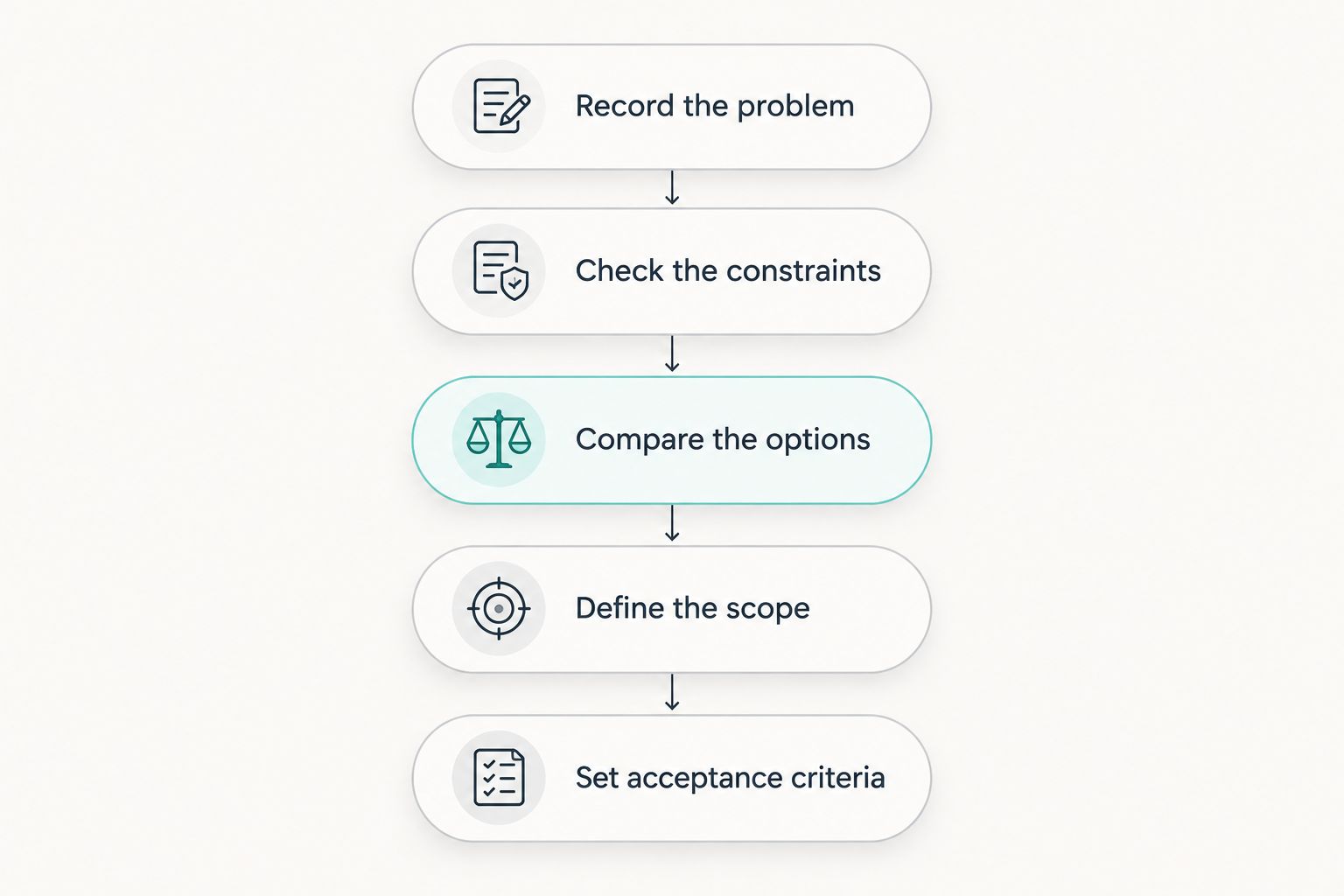
Define the workplace problem before deciding which building work to approve.
A useful acceptance criterion describes a result you can check. For a meeting room, that means stating its intended use and the requirements that follow from it, rather than approving the room on appearance alone.
Keep unresolved conditions visible in the decision document. If an inspection or permission determines whether the proposal works, settle that dependency before approving the affected work.
What should you ask before approving a renovation proposal?
Ask for a clear connection between the brief and the proposed work. You need to understand not only what is included, but also what the completed project is intended to achieve.
Use these questions when reviewing a proposal:
- Which workplace requirement does each major item address?
- What has been inspected, and what remains an assumption?
- Which permissions are required, and who obtains them?
- What work is expressly excluded?
- Which activities must stop or move during construction?
- How are changes approved and recorded?
- What information and checks form part of handover?
Do not approve an unclear scope simply because the presentation looks finished. Resolve competing interpretations while the work is still a proposal.
When you are ready to ask about a project, share the problem statement alongside your requirements. The contact page provides a place to make that enquiry.
Is renovating an office better than moving?
Renovating an office is the better fit when the premises meet your essential requirements and the proposed work resolves the remaining problems. Moving deserves comparison when location, building limitations or lease conditions prevent that outcome.
Compare the complete transition for each option, not a renovation scope against an empty alternative. The relocation assessment also needs to account for the requirements of the proposed premises and the move itself.
Can you renovate an office while staff keep working?
Keeping staff at work during renovation depends on whether the proposed arrangements provide suitable separation, access and working conditions. Do not promise normal operations before the work sequence and site requirements have been assessed.
Ask for an occupancy plan that identifies affected activities, temporary locations and responsibility for communicating changes. If the plan relies on remote working, confirm that the affected activities can actually operate that way.
Should you renovate before your lease ends?
Renovating before a lease ends requires checking how the proposed work relates to the remaining tenancy, renewal plans and alteration obligations. Permission to occupy the office does not answer every question about changing it.
Read the relevant lease provisions and obtain the appropriate advice or permissions. Keep uncertain renewal plans separate from confirmed tenancy arrangements when deciding what work to approve.
FAQ
Is office renovation worth it in 2026?
Office renovation is worth it in 2026 when it addresses a defined workplace problem and compares favourably with repairs, refurbishment or relocation. Include disruption, lease conditions and maintenance in the decision.
What is the best reason to renovate an office?
The strongest reason to renovate an office is a specific workplace requirement that the proposed work can satisfy. Define that requirement before selecting finishes or approving a layout.
Is a light office refurbishment enough?
A light refurbishment is enough when the existing layout works and the required changes are limited to selected elements. It is not a substitute for assessing infrastructure or building constraints.
Should I repair the office instead of renovating it?
Choose repairs when you have isolated defects in an otherwise suitable office. Check whether the wider workplace complaint would remain after the repair.
What should I check before renovating rented offices?
Check the lease, landlord permissions and responsibilities for alterations before renovating rented offices. Clarify any end-of-lease obligations that apply to the proposed work.
How do I know whether an office renovation worked?
Judge the renovation against acceptance criteria agreed before construction. Check the completed work against the original workplace requirements rather than appearance alone.
Who is this Giant Leap office renovation guide for?
This Giant Leap office renovation guide is for teams deciding whether to improve their current premises. It helps structure the comparison between repairs, refurbishment, renovation and relocation.
One last thing
Write down what you intend to keep. A renovation brief that lists only changes leaves suitable existing elements without an explicit decision.
For your 2026 project, add a retain list beside the proposed scope and check it during design reviews. The right renovation is the work that solves the problem—not every change you can imagine.