
Relocating is better than renovating an office in 2026 when your current premises cannot meet your essential requirements, even after alterations. Renovating is better when the location and building still work, but the layout, finishes or workplace facilities do not. Choose the option that solves the underlying problem, then compare its full cost and operational disruption—not just the construction or moving bill.
TL;DR
- Relocating vs renovating an office starts with whether the current building can meet your essential requirements.
- Relocation suits teams whose location, capacity or building constraints cannot be fixed through alterations.
- Renovation suits teams with suitable premises but an unsuitable office layout.
- Use Giant Leap’s decision guide to compare lease constraints, business continuity and future space needs.
Why this matters
An office project can improve how your team works without fixing why the premises no longer suit the business. New meeting rooms do not solve an inaccessible location; a new address does not automatically solve poor space planning.
This Giant Leap guide separates the decision into building suitability, operational needs and delivery constraints. For your 2026 assessment, write the problem before choosing the project: what must change, what can stay, and what would make either option unacceptable?
Giant Leap’s office decision guide is best for teams deciding whether their premises need replacing or their layout needs changing.
Is relocating better than renovating an office in 2026?
Relocating is better when the current premises fail a requirement that refurbishment cannot reasonably address. Renovating is better when the building remains suitable and the required changes fit within its physical and lease constraints.
Neither option wins by default. Compare both against the same workplace brief rather than judging an attractive new office against an unresolved version of your current one.
Best for
- Relocating: Teams needing a different location, building or usable capacity
- Renovating: Teams whose existing premises work but whose layout needs changing
Main advantage
- Relocating: Allows you to select premises against a fresh brief
- Renovating: Retains a suitable location while changing the workplace
Main limitation
- Relocating: Requires a move and coordination between premises
- Renovating: Remains subject to the existing building’s constraints
Operational risk to plan for
- Relocating: Cutover of people, equipment, access and IT
- Renovating: Working around construction or arranging temporary accommodation
Lease issue to check
- Relocating: Exit obligations and the terms of the replacement lease
- Renovating: Alteration permissions and obligations at lease end
Deciding test
- Relocating: Does another property solve a problem this one cannot?
- Renovating: Can alterations deliver the required workplace here?
Start with requirements, not preferences
Separate essential requirements from desirable improvements. An essential requirement determines whether a property remains viable; a preference helps you choose between otherwise viable options.
For example, needing accessible premises is different from preferring a brighter reception area. Needing more usable workspace is different from wanting a different furniture arrangement. Treating every preference as essential makes relocation look necessary before you have tested renovation properly.
Relocating: best for constraints you cannot fix in place
Relocation deserves priority when the address or building is the problem. Examples include a location that no longer suits your operations, insufficient usable space after realistic replanning, or essential facilities that the existing premises cannot accommodate.
The benefit is choice. You can assess alternative properties against your requirements rather than designing around the same limitations again.
The drawback is that changing premises introduces a separate transition project. You need to coordinate lease dates, access, fit-out, equipment transfers and the point at which work switches to the new office.
What to establish before choosing relocation
- The unsolved constraint: Name the requirement the existing premises cannot meet.
- The replacement brief: Set out what another property must provide.
- The exit position: Check notice requirements, reinstatement obligations and handover conditions in your lease.
- The transition plan: Identify how staff, systems and equipment will move without leaving essential work unsupported.
Choose relocation when a different property solves a documented problem that a workable renovation cannot. Do not choose it solely because a viewing feels more promising than a tired existing office.
Renovating: best for suitable premises with an unsuitable layout
Renovation deserves priority when the location, building and lease position remain suitable. Changes to the arrangement of workstations, meeting spaces, storage or shared areas can address problems that do not require a new address.
The benefit is continuity of place. You retain a location your business already uses while changing the parts of the office that are not working.
The drawback is constraint. Structural features, building services, permissions and occupied working conditions still shape what you can deliver. Staying put does not mean the project will be simple or disruption-free.
What to establish before choosing renovation
- A workable layout: Confirm that the proposed arrangement meets the actual brief.
- Permission to alter: Check the lease and obtain the approvals required for the intended work.
- Construction separation: Establish whether staff can work safely away from the affected areas.
- A useful occupancy period: Assess whether the business expects to remain long enough to benefit from the changes.
Choose renovation when a feasible design resolves the problem without retaining an unacceptable building or location constraint. A cosmetic refresh is not a substitute for that test.
How do you compare relocation and renovation fairly?
Use the same brief, assessment period and operational assumptions for both options. Otherwise, one proposal can appear stronger simply because it excludes work or disruption that the other includes.
For a 2026 decision, assess immediate delivery separately from longer-term suitability. A quick solution that leaves an essential requirement unresolved is not a complete solution.
1. Write the brief
List the activities the office must support: focused work, meetings, collaboration, visitor access, storage and any specialist operational needs. Include only activities your business actually requires.
Describe what success looks like in practical terms. Replace a vague instruction such as a better office with a requirement such as enclosed space for confidential calls.
2. Test feasibility
Check whether each option can meet the essential requirements. For renovation, test a proposed layout rather than assuming the existing floor area is sufficient; for relocation, test the actual property rather than relying on its advertised size.
Record unresolved questions as conditions to satisfy before approval. An unconfirmed permission or untested layout should not count as a completed requirement.
3. Compare obligations
Read the relevant lease provisions alongside the project scope. Separate obligations that apply regardless of your decision from obligations created by moving or altering the premises.
Do not assume that paying for improvements removes reinstatement duties. Equally, do not assume the current premises can be handed back without work: establish what the lease requires.
4. Plan continuity
Map how essential work will continue during construction and transition. Identify where people will work, which systems must remain available and who authorises the switch to the completed office.
A renovation plan needs an answer for noise, access and work-area separation. A relocation plan needs an answer for equipment transfers, connectivity and first-day access.
5. Approve the scope
Compare written scopes with clear inclusions, exclusions, responsibilities and completion conditions. Resolve material gaps before treating either proposal as ready for approval.
Approve the option that meets the brief with acceptable obligations and disruption—not the option with the shortest proposal.
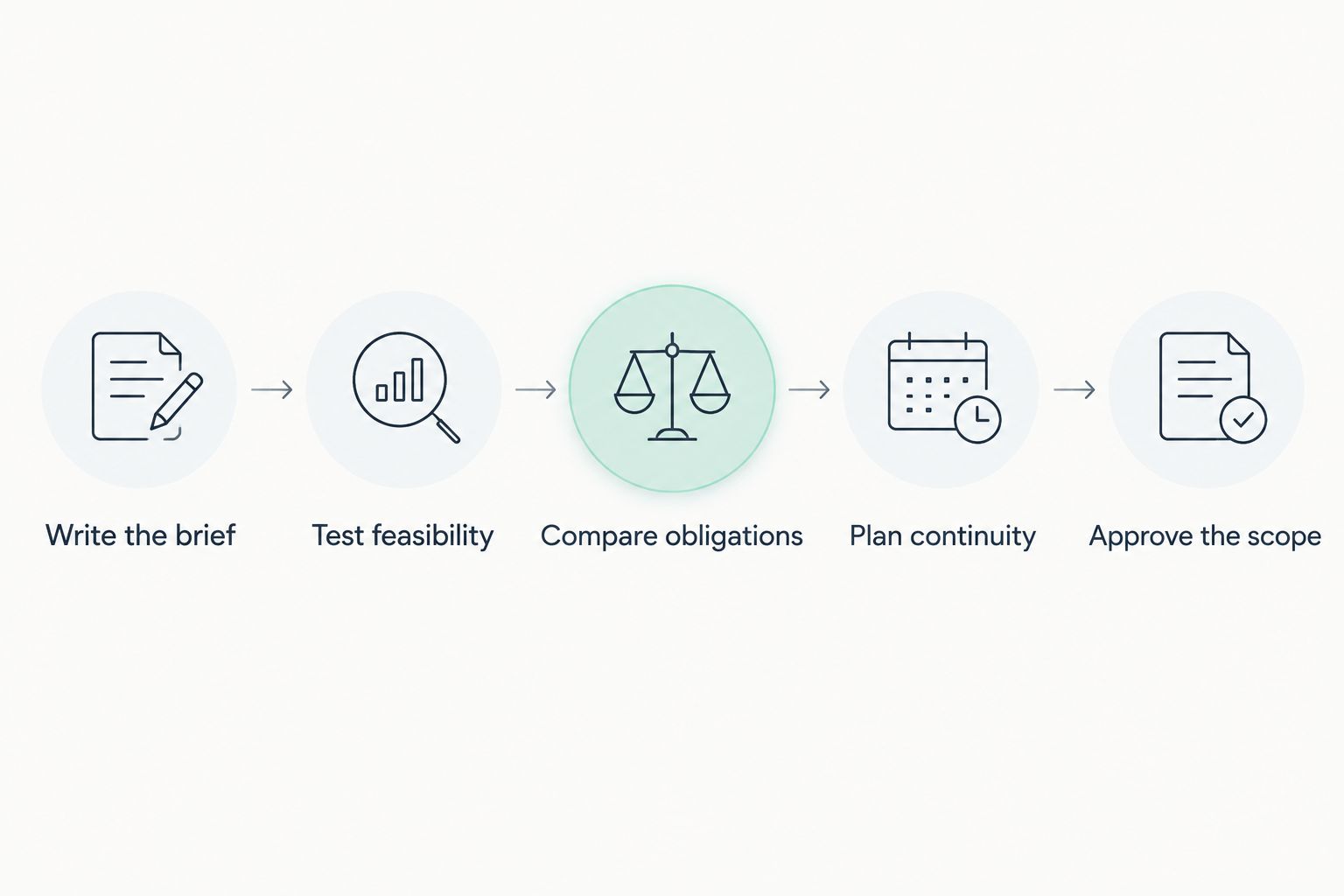
Test feasibility before comparing proposals as if both options are ready to proceed.
Why the right office decision varies
The same workplace complaint can lead to different decisions because the underlying constraints differ. Use these factors to explain your choice, not a general assumption that moving or staying is always better.
- Location suitability: Renovation changes the interior, not the address. Assess staff access, visitor needs and operational requirements separately from appearance.
- Usable capacity: Judge the space against a workable layout. Floor area alone does not establish whether the required activities fit.
- Lease position: Remaining commitments, alteration permissions and exit obligations affect which option is practical.
- Building constraints: Check whether the structure and services can support the intended changes before committing to a design.
- Business continuity: Decide whether the business can tolerate phased works, temporary accommodation or a coordinated move.
- Future requirements: Test the brief against credible staffing and working-pattern scenarios rather than treating today’s arrangement as permanent.
Compare the same planning periods
Use a 12-month delivery view to examine preparation, approvals, works and transition. This is an assessment window, not a promised project duration.
Then use a 3-year occupancy view to test whether the chosen office still supports your expected operations. If a longer commitment is under consideration, add a 5-year scenario and identify which assumptions become less certain.
These suggested periods keep immediate convenience separate from lasting suitability. They are not benchmarks or a reason to forecast headcount you cannot substantiate.
Is renovating less disruptive than moving offices?
Renovating is less disruptive only when work can be separated from normal operations effectively. Remaining at the same address does not remove construction noise, restricted access or the need to relocate staff temporarily.
Moving concentrates attention on the transition between premises, but the preparation still needs careful coordination. Compare the actual continuity plans rather than labelling renovation easy and relocation disruptive.
For your 2026 plan, identify the activities that cannot stop and give each an owner, a temporary arrangement and a recovery procedure. That makes disruption a planning issue rather than an assumption.
Should you relocate when the office feels too small?
Relocate when a realistic layout cannot accommodate your essential activities. An office that feels crowded can also have poorly allocated meeting rooms, storage or circulation space, so test the arrangement before deciding the building is too small.
Start with how the office is used, not just how many desks it contains. Include peak attendance and the spaces people need while they are present; do not treat unused desks as proof that every other facility is sufficient.
Should you renovate before renewing the lease?
Resolve the lease position before committing to substantial alterations. Your expected occupation period, permission to carry out the work and end-of-lease duties belong in the decision together.
A renewal discussion and a renovation design should use the same workplace brief. Otherwise, you risk agreeing to remain before confirming that the building can support the office you need.
FAQ
Is relocating better than renovating an office in 2026?
Relocating is better when the current address or building cannot meet essential requirements after realistic alterations. Renovating is better when suitable premises need a different layout or facilities.
How do I know whether our office needs renovation or relocation?
Test whether a feasible renovation can satisfy your essential workplace requirements. If an unacceptable location, capacity or building constraint remains, assess relocation against the same brief.
Is staying in the same office always less disruptive?
Staying in the same office is not always less disruptive. Occupied renovation requires a plan for construction separation, access and essential work, while relocation requires a coordinated transition between premises.
What should I check in the lease before renovating?
Check alteration permissions, approval requirements and any reinstatement obligations before renovating. Assess the intended work alongside the period you expect to occupy the premises.
Can changing the layout solve an overcrowded office?
Changing the layout can address overcrowding when poor space allocation is the cause. Test the proposed arrangement against work activities and attendance before assuming that the building has sufficient capacity.
Should office relocation and renovation proposals include the same things?
Office relocation and renovation proposals should address the same workplace requirements and assessment period. Their scopes will differ, but both need clear inclusions, exclusions, responsibilities and continuity arrangements.
What is the biggest mistake when comparing relocation and renovation?
The biggest decision error is choosing a project before identifying the problem it must solve. An attractive replacement office or a refreshed interior is not sufficient if an essential requirement remains unmet.
One last thing
Write down what would make each option fail before asking which one you prefer. If relocation keeps the same operational problem at a different address, it fails; if renovation leaves an essential building constraint unresolved, it fails too.
For a 2026 decision, give both options the same test: can the business work effectively here once the project is complete? Keep that question at the top of the brief, even when finishes and floor plans start competing for attention.