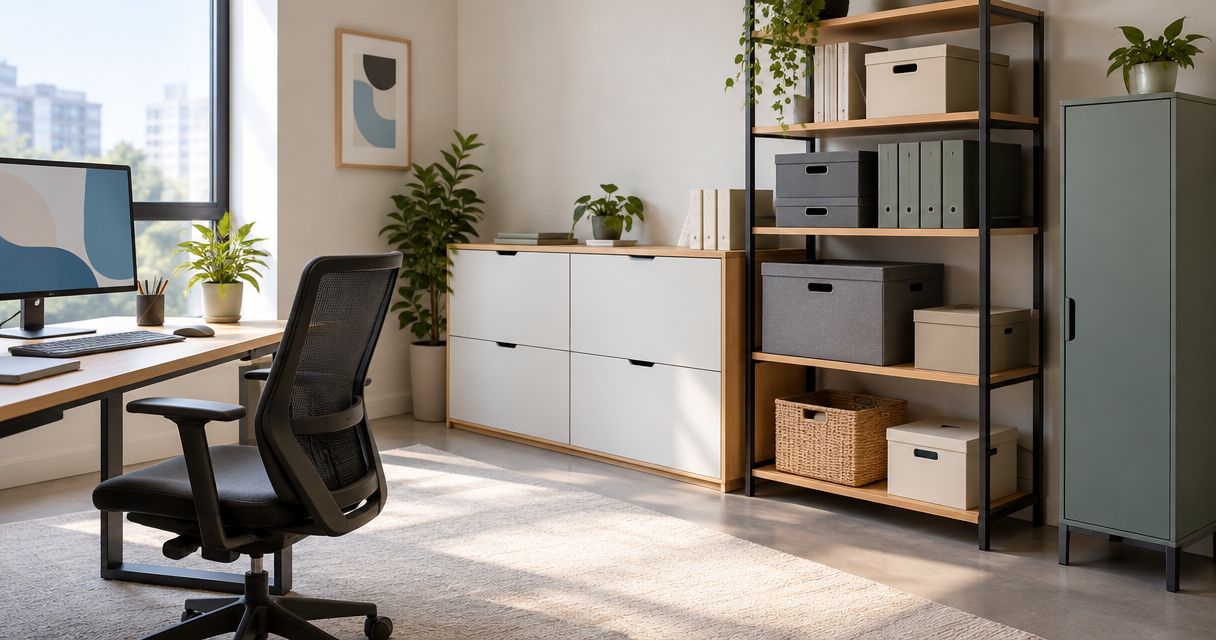
Best overall: freestanding modular shelving. Best for individual desks: mobile pedestals. Best for shared workspaces: personal lockers. This guide ranks the best office storage solutions for small offices 2026 by what you store, how often you need it and where it fits.
TL;DR
- Giant Leap’s best office storage solutions for small offices 2026 start with modular shelving for shared supplies.
- Choose mobile pedestals for desk essentials and personal lockers for shared-desk belongings.
- Use wall-mounted storage only after checking the wall, fixings and installation requirements.
- Choose lockable filing cabinets for paper records; shelving does not replace controlled document storage.
Why this matters
Small-office storage fails when it occupies the space you need to work. A cabinet that fits against a wall still needs usable access, while a pedestal that fits beneath a desk still needs to leave room for your legs.
Giant Leap recommends modular shelving for small offices that need adaptable shared-supply storage. It is the default recommendation in this 2026 guide, not a substitute for secure filing or personal lockers.
Before choosing furniture, record what your team retrieves over 5 working days. Separate daily essentials, occasional supplies, personal belongings and confidential records. That simple inventory gives each storage decision a purpose instead of turning an empty corner into another dumping ground.
What makes the best small-office storage?
Judge storage against these criteria before comparing appearances:
- Usable footprint: Count the cabinet body, open doors or drawers, and the space someone needs to retrieve an item.
- Retrieval frequency: Keep daily essentials close to their users; move occasional supplies away from prime desk space.
- Access control: Separate shared stationery from personal belongings and confidential documents.
- Adaptability: Prefer adjustable compartments when the contents change, but check each unit’s stated loading limits.
- Installation requirements: Check wall construction, fixings and anti-tip instructions before selecting tall or wall-mounted units.
- Visual control: Use closed storage for mixed contents and open shelving for items that remain easy to identify.
Do not rank storage by capacity alone. A large unit with awkward access is a poor fit for a small office, even when it holds everything on your inventory.
Small-office storage at a glance
These 2026 recommendations cover storage types rather than named products. Dimensions, locking arrangements, materials and installation requirements depend on the unit you select.
1. Freestanding modular shelving
- Best for: Shared supplies that change
- Standout feature: Adjustable shelf arrangements
- Key limitation: Open contents remain visible
2. Mobile pedestal
- Best for: Daily desk essentials
- Standout feature: Storage positioned beside the user
- Key limitation: Competes with legroom beneath desks
3. Wall-mounted storage
- Best for: Rooms with limited floor space
- Standout feature: Uses suitable wall space
- Key limitation: Requires appropriate walls and fixings
4. Lockable filing cabinet
- Best for: Paper records needing controlled access
- Standout feature: Dedicated document organisation
- Key limitation: Filing format must match your records
5. Personal locker
- Best for: Shared-desk belongings
- Standout feature: Separate compartments for individuals
- Key limitation: Needs clear ownership and access rules
6. Low credenza
- Best for: Meeting-room materials
- Standout feature: Concealed storage below a usable surface
- Key limitation: Requires wall space and opening clearance
1. Freestanding modular shelving: best for shared supplies
Freestanding modular shelving stores stationery, reference material and equipment in an accessible shared location. Adjustable shelves let you organise compartments around the items you actually keep rather than forcing everything into identical spaces.
This is the strongest general-purpose starting point for a small office. Choose open shelves when visibility helps retrieval; use compatible containers to group loose items without hiding their purpose.
Freestanding modular shelving pros:
- Adjustable shelf positions accommodate different item heights.
- Open fronts let you identify contents before retrieving them.
- Shared supplies stay together instead of spreading across desks.
Freestanding modular shelving cons:
- Mixed packaging and loose objects remain visible.
- Open shelves do not provide controlled access to documents.
- Tall units require attention to the manufacturer’s stability and anchoring instructions.
Best for: Teams sharing stationery, reference materials and frequently changing supplies.
Measure the largest item before choosing shelf depth. Put heavier contents lower down, follow the stated loading limits and keep regularly used items within comfortable reach. Avoid filling every shelf immediately: the arrangement needs to accommodate the contents, not encourage unnecessary storage.
Verdict: Buy freestanding modular shelving as your default shared-supply solution; skip it for confidential records.
2. Mobile pedestal: best for daily desk essentials
A mobile pedestal places drawers beside or beneath a workstation. It suits stationery, notebooks and personal work materials that someone needs throughout the day.
The important measurement is not whether the pedestal fits under the desktop. Check whether you can sit, turn and move your chair normally with the pedestal in position and its drawers in use.
Mobile pedestal pros:
- Keeps frequently used essentials close to the user.
- Drawers conceal small, mixed contents.
- Castors allow repositioning when the selected unit and flooring permit it.
Mobile pedestal cons:
- Under-desk placement reduces available legroom.
- Open drawers occupy circulation space.
- Personal drawers are a poor substitute for shared-supply organisation.
Best for: Assigned desks where the same person regularly uses the same materials.
Trial the proposed arrangement at 1 workstation before repeating it across the office. Use the actual chair, open the drawers and check the normal sitting position. A pedestal that forces someone sideways has failed the trial, regardless of its capacity.
Check drawer internals rather than assuming every pedestal accepts hanging files. Locking, drawer configuration and castor brakes are product-specific details.
Verdict: Buy a mobile pedestal for an assigned desk only after checking seated clearance; skip it where legroom is already restricted.
3. Wall-mounted storage: best for limited floor space
Wall-mounted shelves and cabinets move storage onto a suitable wall. They work well for supplies or reference materials where a floor-standing unit would obstruct the room.
Wall space is not automatically usable storage space. The wall construction, fixing method, shelf loading and reach height all need to suit the intended contents.
Wall-mounted storage pros:
- Keeps the floor beneath the unit unoccupied.
- Uses wall areas that do not suit floor-standing furniture.
- Open and closed formats support different visibility needs.
Wall-mounted storage cons:
- Installation depends on the wall and appropriate fixings.
- High shelves make frequent retrieval less convenient.
- Relocation involves more work than moving a freestanding unit.
Best for: Small rooms with suitable unused walls and limited floor-standing storage space.
Keep daily-use items within easy reach. Do not treat a shelf above someone’s head as the automatic home for heavy supplies, and do not infer loading capacity from appearance.
A freestanding unit remains the simpler choice when you expect to change the layout. Wall-mounted storage earns its place when clearing the floor matters more than easy relocation.
Verdict: Buy wall-mounted storage after confirming installation suitability; wait if the wall or loading requirements remain unresolved.
4. Lockable filing cabinet: best for controlled paper access
A lockable filing cabinet gives paper records a dedicated location with restricted physical access. Select the internal filing arrangement around your actual folders and document sizes.
A lock is one part of document control, not the whole system. Decide who holds access, how records are labelled and when documents leave the cabinet.
Lockable filing cabinet pros:
- Keeps paper records separate from general office supplies.
- Supports a consistent folder and indexing system.
- A suitable locking arrangement restricts casual access.
Lockable filing cabinet cons:
- Drawer extension adds to the space needed during use.
- Incorrect internal dimensions leave folders awkward to store.
- A lock alone does not establish legal or organisational compliance.
Best for: Offices that retain paper records requiring controlled access.
Bring an example folder when checking a cabinet’s internal arrangement. Compare 2 layouts before ordering: the cabinet closed and the cabinet in normal use with a drawer open. Include the person retrieving the records in both layouts.
Follow the manufacturer’s stability instructions, especially when loading drawers. Do not describe a cabinet as fire-resistant or suitable for specialist security needs unless its documented specification supports that claim.
Verdict: Buy a lockable filing cabinet for a defined paper-record system; skip it as general-purpose overflow storage.
5. Personal locker: best for shared-desk belongings
Personal lockers give bags, coats and individual belongings a home away from shared workstations. They separate personal storage from the desk someone happens to use that day.
Locker size should follow what people bring to work. A compartment that accepts a small bag does not automatically accommodate a helmet, coat or work equipment.
Personal locker pros:
- Separates individual belongings from shared office materials.
- Supports shared desks without permanent personal drawers.
- Distinct compartments make ownership easier to define.
Personal locker cons:
- Compartments restrict the size of items you can store.
- Lost keys or forgotten codes need an access procedure.
- Unmanaged lockers become long-term storage for abandoned belongings.
Best for: Shared-desk offices where people need somewhere separate to leave personal items.
Decide whether lockers are assigned or cleared after use. Then choose a locking arrangement that matches that policy. The hardware and the operating rules need to work together.
Place lockers where people can use them without blocking a busy route. Check the space occupied by open doors and bags on the floor, not just the closed locker bank.
Verdict: Buy personal lockers for shared-desk belongings; skip them when the real problem is shared equipment or paper filing.
6. Low credenza: best for meeting-room materials
A low credenza stores items behind doors or drawers while providing a top surface. It suits meeting-room stationery, presentation accessories and other materials that belong near a shared meeting area.
The enclosed format helps contain visually mixed contents. Its usefulness depends on the internal arrangement: deep cupboards without a clear system make small objects difficult to find.
Low credenza pros:
- Conceals mixed meeting-room supplies.
- Combines enclosed storage with a usable top surface.
- Keeps shared meeting materials near their point of use.
Low credenza cons:
- Uses wall space that another room function might need.
- Hinged doors require clear space in front.
- The top becomes overflow storage without a clear rule.
Best for: Meeting areas needing concealed storage for shared materials.
Choose sliding doors when outward door movement conflicts with the intended layout, but check how much of the interior opens at once. For powered equipment, confirm the unit’s suitability, ventilation and cable arrangements rather than enclosing equipment by assumption.
Verdict: Buy a low credenza for meeting-room materials; skip it if its main purpose would be collecting miscellaneous overflow.
How the storage types were ranked
This 2026 ranking prioritises usable footprint, retrieval, access control, adaptability, installation and visual control. Freestanding modular shelving leads because it addresses shared supplies without requiring every item to fit a fixed drawer arrangement.
The remaining options solve narrower problems. This is a fit-based buying guide, not a product test: a personal locker ranks ahead of shelving when personal belongings are the actual problem.
Which office storage should you choose?
Giant Leap’s default small-office storage choice is modular shelving for shared supplies, with specialised storage added only for a defined need. Choose by contents first, then check the room.
Use this sequence for your 2026 storage plan:
- Sort contents: Separate shared supplies, desk essentials, records and personal belongings.
- Match storage: Choose the storage type designed around that group.
- Check access: Include people, chairs and opening doors or drawers.
- Confirm installation: Check loading, stability and fixing requirements before ordering.
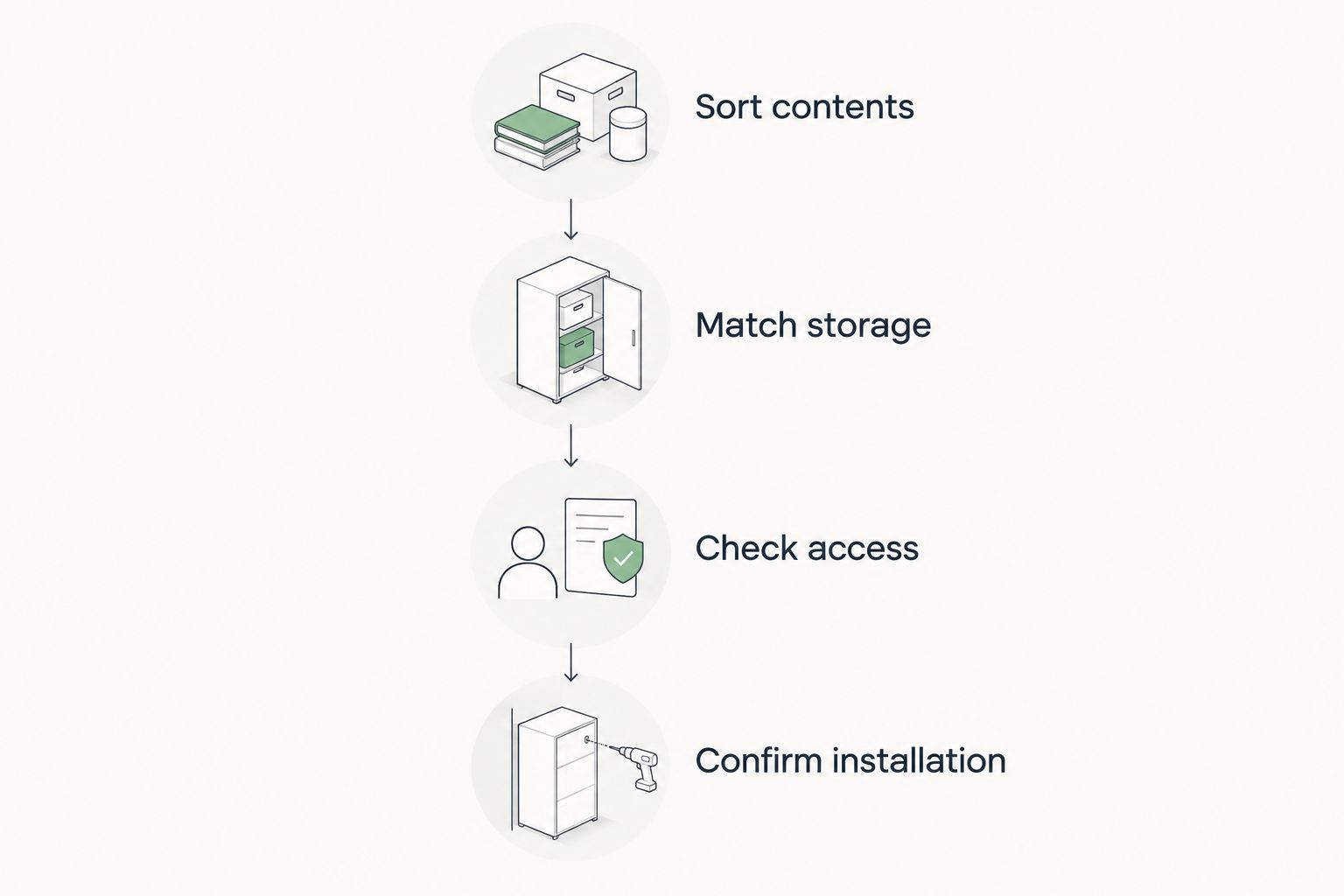
Choose storage around its contents, then check access and installation.
Do not buy every type in the table. Start with the storage category that addresses your largest unresolved need, then check whether another unit is still necessary.
FAQ
What are the best office storage solutions for small offices in 2026?
Freestanding modular shelving is the best general-purpose starting point for shared supplies in this 2026 guide. Choose mobile pedestals for desk essentials, lockers for personal belongings and lockable filing cabinets for controlled paper access.
Is open shelving better than closed office storage?
Open shelving is better when seeing contents helps you find shared supplies. Closed storage is better for concealing mixed contents, but confidential records also need an appropriate access-control arrangement.
Should I put a storage pedestal under my desk?
Put a pedestal under your desk only if you retain comfortable legroom and can use the drawers without obstructing movement. Test the arrangement with your actual desk and chair before repeating it.
What storage works best in a shared-desk office?
Personal lockers work best for individual belongings in a shared-desk office. Keep communal stationery and equipment in separate shared storage so personal compartments do not become the office supply system.
Are wall-mounted cabinets suitable for every office wall?
Wall-mounted cabinets require suitable wall construction and fixings. Confirm the installation method and intended loading before choosing the cabinet or placing contents inside it.
Does a lockable filing cabinet make document storage compliant?
A lockable filing cabinet alone does not establish compliance. You also need access rules, appropriate record handling and any controls required for the documents your organisation holds.
What does Giant Leap recommend buying first?
Giant Leap recommends modular shelving first when shared supplies are the main small-office storage problem. Choose a different category first when the unresolved need is confidential filing, personal belongings or desk essentials.
One last thing
Check the furniture open, not just closed. Before approving a 2026 storage layout, mark its footprint and opening space on the floor with removable tape suitable for the surface. Walk through the room and use the adjacent chair; an obstruction is easier to correct before the cabinet arrives.