
Best overall for dry-area flooring: natural linoleum. Best for feature walls: reclaimed timber. Best for refreshing retained surfaces: low-emission paint. This Giant Leap guide compares the best sustainable materials for commercial interior design 2026 by application, maintenance and the evidence you should request before specifying them.
TL;DR
- The best sustainable materials for commercial interior design 2026 depend on application, durability and verified environmental evidence.
- Natural linoleum is the default flooring shortlist choice; reclaimed timber suits feature walls with documented provenance.
- Recycled metal suits demountable components; cork suits quieter rooms where furniture loads are controlled.
- Giant Leap’s sustainable materials guide prioritises retaining serviceable interiors before buying replacement finishes.
Why this matters
A sustainable material is not automatically a sustainable specification. The finished assembly also includes adhesives, coatings, backing layers and maintenance products. Replacing a serviceable surface with a greener-looking alternative still creates a replacement project.
For a commercial interior in 2026, start with what you can retain. Then assess the materials you actually need against traffic, cleaning, moisture and future alterations. A finish that fails its intended use is a poor environmental choice, regardless of its recycled content.
Giant Leap’s sustainable materials guide is for commercial teams choosing finishes by evidence, not environmental labels. Use the shortlist below to match each material to a specific job rather than searching for one winner across floors, walls and furniture.
What makes the best sustainable commercial interior materials?
- Retention potential: Can you repair, refinish or reuse the existing material instead of replacing it? Assess this before comparing new products.
- Application fit: Match abrasion, moisture, fire and cleaning requirements to the actual location. Decorative suitability does not establish suitability for a busy circulation route.
- Environmental evidence: Request an environmental product declaration where available, supported by clear information about composition and sourcing. Compare equivalent functions, not unrelated headline figures.
- Indoor emissions: Check the finished product and installation system for relevant emissions test evidence. Low volatile organic compound content and low emissions are different claims.
- Repair and maintenance: Prefer finishes you can maintain or repair without replacing an entire assembly. Confirm that your cleaning team can follow the specified care method.
- End-of-use route: Ask how components separate and where they go after removal. Recyclability needs a practical collection and processing route, not just a symbol.
Use these criteria in that order. A well-documented product still fails the brief if it cannot withstand the room, and an attractive recycled finish still needs a workable installation method.
Sustainable materials at a glance
The order below puts the default flooring choice first, followed by materials that solve different commercial interior problems. It is not a claim that flooring has greater environmental value than walls or furniture.
Natural linoleum
- Best for: Dry-area circulation flooring
- Standout feature: Renewable ingredients in the wear surface
- Key limitation: Moisture conditions and maintenance need checking
Reclaimed timber
- Best for: Feature walls and reused joinery
- Standout feature: Reuses existing timber
- Key limitation: Variable condition, dimensions and previous treatments
Recycled metal
- Best for: Demountable frames and trims
- Standout feature: Durable components that can be mechanically fixed
- Key limitation: Recycled content does not establish total environmental impact
Cork
- Best for: Quiet rooms and low-impact flooring
- Standout feature: Resilient surface made from harvested bark
- Key limitation: Indentation and moisture require attention
Recycled PET felt
- Best for: Decorative acoustic wall treatments
- Standout feature: Turns recycled polyester into lightweight panels
- Key limitation: Assembly performance and end-of-use routes vary
Certified timber
- Best for: New furniture and interior joinery
- Standout feature: Traceable sourcing through certification
- Key limitation: Certification does not cover every finished-product impact
Low-emission paint
- Best for: Refreshing retained walls and ceilings
- Standout feature: Updates a surface without replacing its substrate
- Key limitation: Low emissions do not guarantee durability or low lifecycle impact
Each material earns its place through a distinct use case. Keep the shortlist tied to your specification: the table is a starting point, not permission to substitute materials without checking performance.
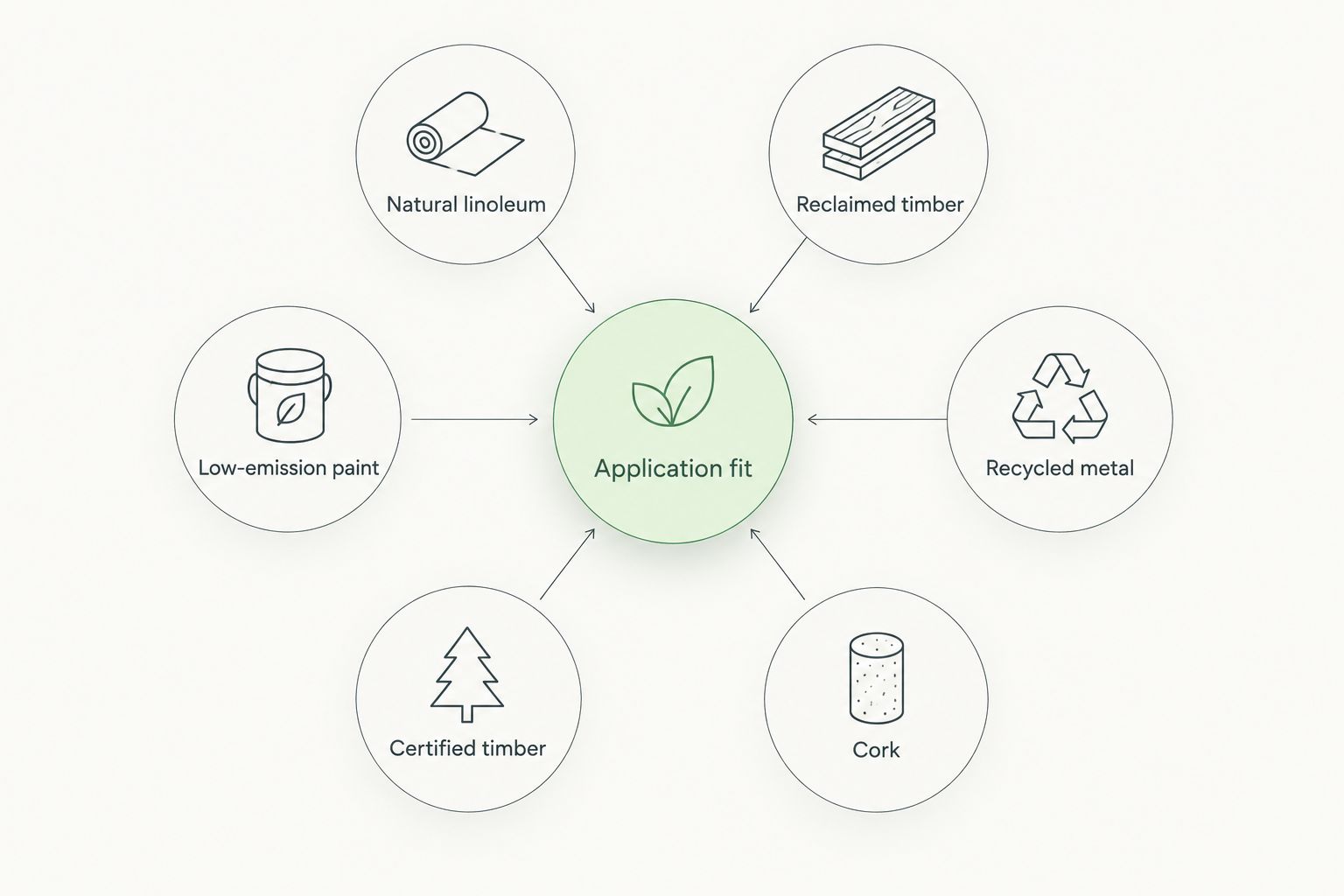
Choose the application first, then assess the material and its installation system.
1. Natural linoleum: best for dry-area circulation flooring
Natural linoleum is a resilient flooring material traditionally made using linseed oil, wood or cork flour, resins and mineral fillers. Product construction varies, so check the backing, finish and installation requirements rather than relying on the material name.
For a 2026 flooring shortlist, natural linoleum belongs in the comparison for corridors and shared dry areas. Specify a product rated for the expected commercial use, and check the substrate before committing to the installation.
Natural linoleum pros:
- Renewable ingredients form part of its composition.
- A resilient surface suits a range of commercial flooring applications.
- Sheet formats allow broad areas with relatively few joints.
Natural linoleum cons:
- Moisture conditions and adhesive selection affect installation suitability.
- Care methods must match the manufacturer's finish and maintenance instructions.
Best for: Dry-area circulation routes where the specified product meets traffic and cleaning requirements.
Ask for the complete floor build-up, not just a sample. Include adhesive emissions, substrate preparation and repair arrangements in the decision. Verdict: Buy for suitable dry areas; skip where moisture conditions fall outside the installation specification.
2. Reclaimed timber: best for feature walls
Reclaimed timber gives existing wood another use in wall cladding, screens and joinery. Its strongest argument is reuse, not a rustic appearance: decorative ageing alone does not prove that timber is reclaimed.
Check provenance, condition and previous treatments before using it indoors. Old paint, embedded metal, contamination and dimensional variation all affect preparation and suitability. Request representative pieces rather than approving the entire batch from one attractive sample.
Reclaimed timber pros:
- Reuses timber rather than requiring newly harvested wood for that component.
- Solid pieces can be worked, refinished and adapted.
- Variation suits feature applications that do not require uniform appearance.
Reclaimed timber cons:
- Previous treatments and contamination need investigation.
- Irregular dimensions and condition complicate detailing and preparation.
Best for: Feature walls and reused joinery where variation is acceptable and provenance is documented.
Detail fixings so the timber can be removed without destroying it. Do not assume that reclaimed boards satisfy structural or fire requirements simply because they are old. Verdict: Buy documented, suitable timber; skip material with unresolved treatment or contamination concerns.
3. Recycled metal: best for demountable frames and trims
Metal with verified recycled content suits furniture frames, partition components and protective trims. Its practical advantage is the ability to make durable components with mechanical connections that support disassembly.
Specify the alloy, finish and actual recycled-content evidence. A recycled-content claim describes an input; it does not account for every impact of processing, transport, coating or fabrication.
Recycled metal pros:
- Durable sections suit exposed edges and frequently handled components.
- Bolted or screwed connections support repair and disassembly.
- Identifiable, separated metals have established recycling pathways.
Recycled metal cons:
- Coatings and mixed-material assemblies complicate recovery.
- Manufacturing impacts still require assessment despite recycled content.
Best for: Frames, trims and partition components designed for future reconfiguration.
Ask the fabricator to show how replacement parts attach and how different materials separate. Avoid bonding a recyclable metal component permanently to a short-lived finish. Verdict: Buy for demountable assemblies; skip recycled-content claims without supporting documentation.
4. Cork: best for quieter, low-impact rooms
Cork comes from harvested cork oak bark and is used in flooring and wall finishes. Cork flooring offers a resilient underfoot surface, but the finished product can also include binders, coatings and backing materials.
Assess furniture loads and cleaning conditions before selecting it for a commercial room. Acoustic comfort is an application-specific question: a cork surface alone does not establish the sound performance of the entire space.
Cork pros:
- Bark harvesting does not require felling the cork oak.
- Its resilient surface suits rooms where underfoot comfort matters.
- Tile formats allow targeted replacement when the installation supports it.
Cork cons:
- Heavy furniture and concentrated loads require indentation checks.
- Moisture tolerance depends on product construction and edge protection.
Best for: Quiet rooms and low-impact areas with controlled furniture loads.
Test the proposed finish against the cleaning method and furniture feet you intend to use. Check whether refinishing is permitted; do not assume every cork product can be sanded. Verdict: Buy for compatible low-impact rooms; skip where loads or moisture exceed the product specification.
5. Recycled PET felt: best for acoustic wall treatments
Recycled PET felt uses recycled polyester in panels and other interior treatments. It is a useful shortlist material for decorative sound absorption, but recycled content and acoustic performance need separate evidence.
For a 2026 acoustic brief, assess the tested assembly, including panel thickness, mounting method and any air gap. A panel's appearance does not reveal its performance, and sound absorption is not the same as sound insulation between rooms.
Recycled PET felt pros:
- Incorporates recycled polyester when supported by product documentation.
- Lightweight panels suit decorative wall applications.
- Mechanical mounting can support removal and repositioning.
Recycled PET felt cons:
- Fire and acoustic suitability depend on the specified product and assembly.
- Adhesives, coatings and collection arrangements affect end-of-use options.
Best for: Decorative acoustic wall treatments with verified assembly performance.
Request fire and acoustic test reports that match the proposed installation. Confirm whether removed panels have an identified recovery route. Verdict: Buy tested assemblies; skip panels selected solely for their recycled-content label.
6. Certified timber: best for new interior joinery
Certified timber is the shortlist choice when reuse cannot meet the dimensions or performance needed for new joinery. Schemes such as FSC and PEFC provide sourcing and chain-of-custody frameworks; the specific product claim still needs checking.
Certification is not a blanket statement about the finished cabinet or desk. Adhesives, composite boards, coatings, hardware and assembly design remain part of the specification.
Certified timber pros:
- Certification provides a framework for checking sourcing claims.
- Solid timber can support repair and refinishing.
- Mechanical joinery and replaceable hardware can extend useful service.
Certified timber cons:
- Certified sourcing does not establish low indoor emissions.
- Composite construction and permanent bonding can limit repair or recovery.
Best for: New furniture and joinery where reclaimed material cannot meet the brief.
Check the supplier's certification and the claim attached to the supplied product. Then assess board emissions and surface finishes separately. Verdict: Buy verified timber with repairable detailing; skip vague sourcing claims without product-level evidence.
7. Low-emission paint: best for refreshing retained surfaces
Low-emission paint belongs on this list because repainting can preserve an existing wall or ceiling assembly. Its role is different from replacing cladding: the sustainability decision starts with keeping the substrate in use.
Ask for emissions evidence and a finish suited to the required cleaning. Water-based paint is not automatically emission-free, and low volatile organic compound content is not the same as a measured indoor emissions result.
Low-emission paint pros:
- Refreshes serviceable surfaces without replacing the underlying assembly.
- Local repairs and touch-ups can avoid full-surface replacement.
- Verified emissions information supports indoor material selection.
Low-emission paint cons:
- Cleaning resistance and adhesion still require separate checks.
- Primers, fillers and other preparation products also need assessment.
Best for: Retained walls and ceilings that need a new finish rather than reconstruction.
Check the preparation system, not just the topcoat. A finish that needs frequent repainting is a poor match for heavily cleaned surfaces. Verdict: Buy a verified, application-suitable coating; skip paint chosen only by an environmental label.
How the materials are ranked
Giant Leap’s sustainable commercial interior materials shortlist ranks by use case, not by an invented environmental score. Natural linoleum leads the flooring shortlist; the remaining materials address different surfaces and components.
For your 2026 comparison, put equivalent products on the same basis. For flooring, compare impacts per 1 m² of installed floor, including required installation materials. Use a declared comparison period—such as a 10-year assessment period—and document maintenance and replacement assumptions rather than treating that period as a promised lifespan.
Request 2 finish samples for shortlisted surfaces: one for appearance review and one for cleaning or handling checks. Samples do not replace laboratory testing, but they help separate aesthetic approval from practical suitability.
Which sustainable materials should you choose?
Choose natural linoleum as the default dry-area flooring candidate, then select other materials by the job they need to perform. Keep reclaimed timber for feature applications, recycled metal for demountable components and certified timber for new joinery with verified sourcing.
In a 2026 refurbishment, retained surfaces deserve the first decision. Low-emission paint can refresh suitable walls; it cannot solve damaged substrates, unsuitable layouts or inadequate acoustic separation.
Before approving the specification, record these decisions:
- What stays, what is repaired and what genuinely needs replacing.
- Which evidence supports sourcing, emissions and required performance.
- Who maintains each finish and how damaged parts are replaced.
- How components separate when the interior changes again.
Reject substitutions that remove the evidence or change the installation system without review. The material name is only the start of the specification.
FAQ
What's the best sustainable material for commercial flooring in 2026?
Natural linoleum is the default shortlist choice for dry-area commercial flooring in this guide. Check the specific product's traffic rating, moisture requirements, emissions evidence and maintenance instructions before specifying it.
Is reclaimed timber more sustainable than certified new timber?
Reclaimed timber prioritises reuse, while certified new timber provides a sourcing framework for newly supplied material. The better project choice depends on condition, preparation, transport, performance and whether reclaimed pieces can meet the brief.
Does recycled content prove that an interior material is sustainable?
No. Recycled content describes part of a material's composition, not its complete environmental impact. Assess manufacturing, installation, durability, maintenance and the actual end-of-use route as well.
Is cork suitable for a busy commercial office?
Cork is suitable where the specified product meets the room's load, traffic and moisture requirements. Check furniture indentation, cleaning methods and edge protection rather than treating all cork flooring as interchangeable.
Are recycled PET panels good for office acoustics?
Recycled PET panels are suitable for sound absorption when the tested assembly meets the acoustic brief. Request evidence for the proposed mounting method and fire requirements; absorption does not establish sound insulation between rooms.
What documents should I request before approving sustainable materials?
Request relevant sourcing documentation, emissions results, performance test reports and installation instructions. An environmental product declaration supports environmental comparison, but it does not by itself prove that a product is suitable for the application.
Where should I start when choosing sustainable commercial interior materials?
Start by identifying what you can retain and repair before selecting replacements. Giant Leap’s sustainable materials guide then matches replacement materials to distinct applications, with sourcing, emissions, maintenance and recovery checks.
One last thing
A material's next use starts with its first fixing. Screws, accessible connections and separable layers give future teams a practical way to remove and reuse components; permanent bonding can turn those same materials into a difficult demolition job.
Add a disassembly detail to your 2026 specification before signing off the finishes. Record how panels, trims and furniture parts come apart, not just how they look on installation day.