
Best overall: commercial luxury vinyl tile for mixed-use offices. Best for quiet work areas: carpet tiles. Best for targeted replacement: carpet tiles. This Giant Leap guide compares the best commercial flooring options for office renovations 2026 by cleaning, acoustics, repairability and installation requirements.
TL;DR
- Giant Leap’s best commercial flooring options for office renovations 2026 guide picks commercial luxury vinyl tile as the default.
- Carpet tiles suit quiet work areas and allow localised replacement of damaged flooring.
- Sheet vinyl suits cleaning-focused spaces; porcelain tiles suit water-exposed areas when slip performance matches the conditions.
- Choose flooring by room function, then check the subfloor, installation requirements and maintenance instructions.
Why this matters
The best office floor is not necessarily the best floor for every room. A reception area, focused work zone and kitchenette place different demands on the surface beneath them. Using one material everywhere simplifies the specification but creates compromises in sound, cleaning or underfoot comfort.
For a 2026 renovation, start with how people use each space. Then assess the existing floor: moisture, unevenness, old adhesive and movement affect what you can install successfully. A finish selected before those checks is an incomplete decision.
Giant Leap’s office flooring guide is best for decision-makers comparing materials room by room before specifying a renovation. The recommendations below concern flooring categories, not particular manufacturers or product ranges.
What makes the best commercial office flooring?
Use these criteria before comparing colours or patterns:
- Traffic suitability: Specify a product intended for commercial use and check its suitability for the actual traffic and rolling loads.
- Acoustic comfort: Assess footfall, chair movement and room acoustics together. Flooring alone does not resolve speech noise.
- Cleaning requirements: Match the finish to likely spills, entrance dirt and the cleaning methods your team can maintain.
- Localised repair: Check whether damage requires replacing a tile, plank, sheet section or refinishing a larger area.
- Subfloor compatibility: Confirm moisture limits, flatness requirements and the preparation method with the flooring supplier and installer.
- Installation disruption: Assess curing, drying, adhesive requirements and room access before agreeing the renovation schedule.
No material wins every criterion. A carpet tile that helps soften a work area is not the default choice beside a sink; a hard surface that handles spills still needs an acoustic plan.
Commercial flooring options at a glance
1. Commercial luxury vinyl tile
- Best for: Mixed-use offices
- Standout feature: Hard-surface cleaning with modular replacement
- Key limitation: Performance depends on specification and subfloor preparation
2. Carpet tiles
- Best for: Quiet desk-based work areas
- Standout feature: Soft surface with replaceable modules
- Key limitation: Spills and embedded dirt need appropriate cleaning
3. Commercial sheet vinyl
- Best for: Cleaning-focused support rooms
- Standout feature: Fewer joints than modular flooring
- Key limitation: Repairs can leave visible patches
4. Porcelain tiles
- Best for: Water-exposed areas
- Standout feature: Hard surface suited to frequent cleaning
- Key limitation: Hard underfoot; grout and slip performance need attention
5. Polished concrete
- Best for: Offices with a suitable exposed slab
- Standout feature: Uses the existing concrete as the finished surface
- Key limitation: Existing slab condition controls the result
6. Commercial linoleum
- Best for: Offices seeking a linseed-oil-based finish
- Standout feature: Distinct material alternative to vinyl
- Key limitation: Installation and maintenance require product-specific care
1. Commercial luxury vinyl tile: best for mixed-use offices
Commercial luxury vinyl tile, commonly called LVT, is a modular resilient floor supplied as tiles or planks. It suits an office that needs a cleanable hard surface across reception, circulation and shared work areas. Commercial LVT is the default recommendation when practical cleaning and modular repair matter more than a soft floor.
Choose the construction for the application rather than assuming every vinyl plank is suitable. Glue-down, loose-lay and locking products have different installation requirements; rolling chairs and heavy furniture also need explicit consideration.
Commercial LVT pros:
- Tiles or planks support localised replacement, subject to the installation system.
- The hard surface suits routine removal of tracked-in dirt.
- Modular layouts let you define areas without switching material categories.
Commercial LVT cons:
- Unevenness or defects in the substrate can affect the finished appearance.
- Hard-surface flooring does not provide the same soft contact surface as carpet.
- Heavy furniture and unsuitable chair castors can damage the surface.
For a 2026 specification, request evidence for the intended commercial use, maintenance instructions and chair-castor compatibility. Keep matching replacement material from the same installation rather than assuming a later order will match.
Best for: Offices combining circulation, reception and shared working areas.
Verdict: Buy commercial LVT for mixed-use areas after confirming substrate and rolling-load suitability.
2. Carpet tiles: best for quiet desk-based work areas
Carpet tiles create a textile floor from individual modules. They suit desk neighbourhoods, meeting rooms and focused work areas where a softer surface and reduced footfall noise matter. Carpet contributes to acoustic comfort, but ceilings, partitions and room layout still influence speech transmission.
The modular format is the main maintenance advantage. A damaged tile can be replaced locally, although replacement tiles can look different beside an older, worn floor.
Carpet tile pros:
- The textile surface softens footfall compared with a hard floor.
- Individual modules allow targeted replacement.
- Patterns and laying directions help distinguish work zones.
Carpet tile cons:
- Spills require prompt treatment using the specified cleaning method.
- Dirt can accumulate within the pile without effective vacuuming.
- Patch replacements can reveal differences in wear or colour.
Check pile construction, backing, rolling-chair suitability and the cleaning regime together. Entrance dirt control matters: even a suitable commercial carpet needs protection from soil carried through the door.
Best for: Desk-based teams and meeting spaces prioritising acoustic comfort.
Verdict: Buy carpet tiles for quiet work zones; skip them where frequent wet spills define the room.
3. Commercial sheet vinyl: best for cleaning-focused support rooms
Commercial sheet vinyl covers a floor in wider sections than modular tiles or planks. It suits support rooms where straightforward cleaning and reduced joint frequency take priority over localised replacement.
Seam treatment and edge details are part of the specification. Welded seams and coved junctions require an appropriate product and installation method; they are not automatic features of every sheet-vinyl floor.
Commercial sheet vinyl pros:
- Larger sheets reduce the number of joints across the floor.
- Specified seam and edge details support a cleaning-focused installation.
- The resilient surface offers an alternative to ceramic flooring.
Commercial sheet vinyl cons:
- Damage repairs can leave a visible patch or additional seam.
- Subfloor defects can show through the finished surface.
- Detailed fitting around fixed joinery requires careful installation.
In a 2026 renovation, decide the wall junction and seam specification before installation. A cleaning-focused room needs more than a suitable material: poorly resolved edges undermine the intended result.
Best for: Utility and support rooms where cleaning drives the brief.
Verdict: Buy commercial sheet vinyl when fewer joints matter more than discreet modular repairs.
4. Porcelain tiles: best for water-exposed office areas
Porcelain tiles provide a hard ceramic surface. They suit office bathrooms and other water-exposed areas when the selected tile’s slip performance matches the conditions. A polished appearance is not evidence of suitability for a wet floor.
Treat tile, grout, adhesive and substrate as one installation system. Porcelain flooring does not replace any waterproofing required beneath it.
Porcelain tile pros:
- The hard surface suits frequent cleaning.
- Individual tiles can be replaced if matching material is retained.
- Product choices include different textures and finishes.
Porcelain tile cons:
- The surface is hard underfoot and reflects sound.
- Grout joints add cleaning considerations.
- Cracking and debonding can result from unsuitable preparation or installation.
Check slip-performance documentation for the actual use conditions. Also confirm floor levels at doorways: the complete tile build-up includes more than the tile itself.
Best for: Bathrooms and other water-exposed areas with a properly specified installation.
Verdict: Buy porcelain tiles for suitable wet-area applications; skip polished finishes without supporting slip evidence.
5. Polished concrete: best for a suitable existing slab
Polished concrete turns a concrete slab into the finished floor through mechanical processing. It belongs on the shortlist when the existing slab is suitable and you accept that its condition influences the appearance.
Cracks, repairs, aggregate exposure and previous coverings can remain visually important. An existing slab is not a blank canvas, and polishing does not guarantee a uniform result.
Polished concrete pros:
- The concrete itself becomes the finished walking surface.
- A suitable slab avoids adding a separate decorative floor covering.
- Existing variations can form part of the intended appearance.
Polished concrete cons:
- Cracks and previous repairs can remain visible.
- The hard surface needs acoustic support elsewhere in the room.
- Slab suitability and treatment requirements need specialist assessment.
Ask for a trial area before agreeing the final finish. Check the proposed treatment and maintenance instructions, particularly around substances that can stain or attack the surface.
Best for: Offices with a suitable slab and an acceptance of visible material variation.
Verdict: Hold until the slab assessment and trial area confirm the result.
6. Commercial linoleum: best for a linseed-oil-based alternative
Linoleum is a resilient flooring material made using ingredients including linseed oil. It is a different material from vinyl, despite the terms sometimes being confused. Commercial linoleum suits buyers who specifically want this material category rather than a vinyl finish.
Environmental decisions still need product-level evidence. Ingredient descriptions alone do not establish emissions, lifecycle performance or end-of-life outcomes.
Commercial linoleum pros:
- It offers a material alternative to PVC-based vinyl flooring.
- Commercial products provide resilient flooring for specified uses.
- Sheet formats support larger areas with fewer joints than small modules.
Commercial linoleum cons:
- Adhesive, moisture and substrate requirements need careful attention.
- Cleaning chemicals must suit the selected product and finish.
- Sheet repairs can remain visible.
For a 2026 project, request the selected product’s technical documentation and environmental declarations where these form part of your brief. Do not substitute a category-level sustainability claim for evidence about the actual floor.
Best for: Buyers deliberately specifying a linseed-oil-based flooring material.
Verdict: Buy commercial linoleum when its documented properties match the project brief.
How to choose flooring room by room
Start with activities, not a building-wide colour scheme. Mark where people concentrate, walk, eat and clean, then assign the material that solves each area’s main requirement.
- Quiet work: Consider carpet tiles where footfall noise and a soft surface matter.
- Shared circulation: Consider commercial LVT where cleanability and modular replacement matter.
- Wet areas: Assess porcelain tiles or an appropriately specified resilient flooring system.
- Support rooms: Consider sheet vinyl when cleaning and joint detailing drive the decision.
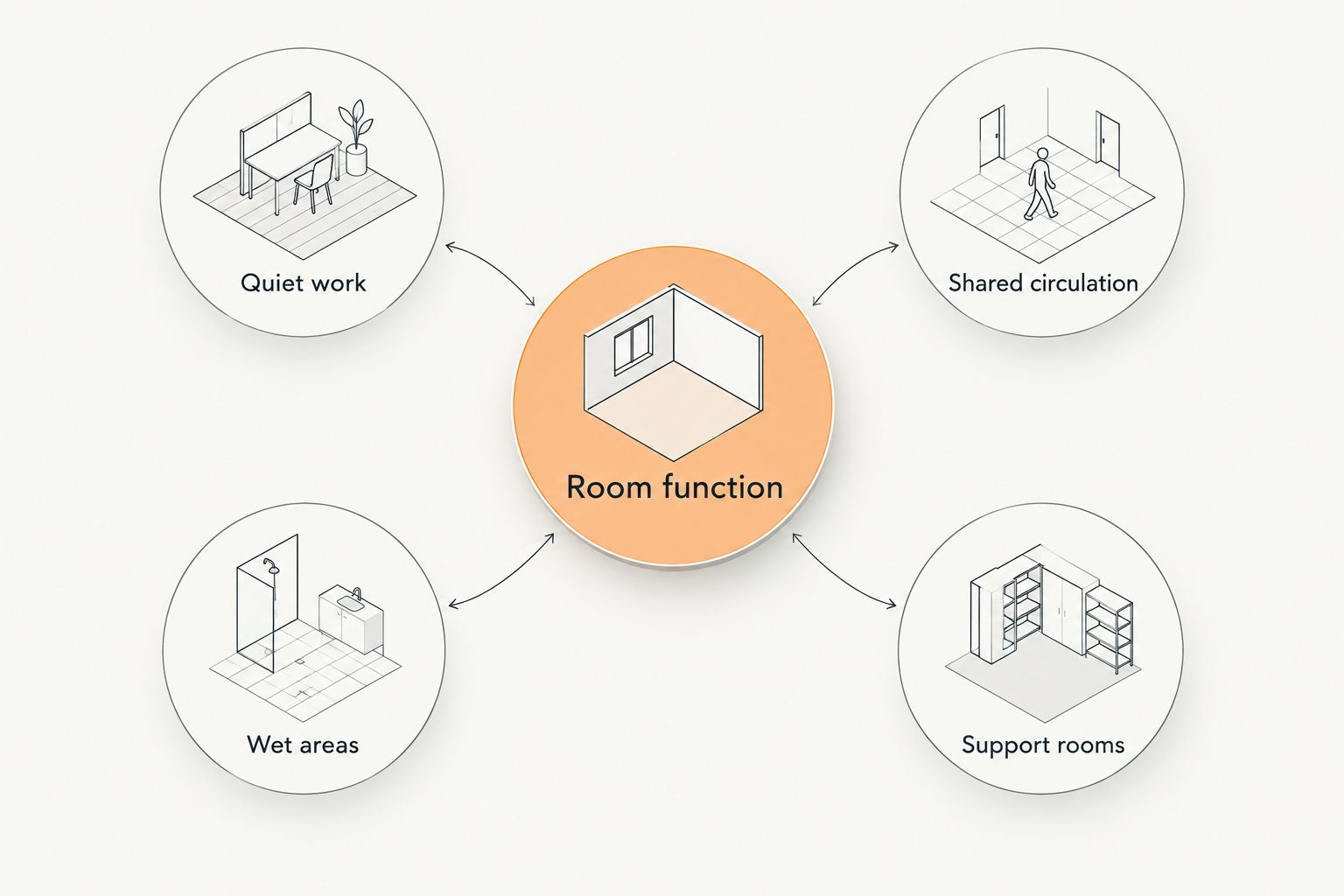
Choose the surface for the activity before coordinating the finishes.
Coordinate transitions early. Changes in floor thickness affect thresholds, doors and accessible movement; junctions also need detailing that resists lifting and does not create a trip hazard.
For Giant Leap readers comparing office flooring options, the useful decision is a room-by-room specification rather than a single material winner. Carry the same visual direction through the office without forcing identical surfaces into incompatible uses.
Check the specification before approving installation
Build these checks into the renovation brief:
- Sample layout: Request a 1 m² sample layout to inspect colour variation, seams and the proposed laying direction.
- Chair trial: Where applicable, trial 2 chair types used in your office on the proposed surface and confirm castor compatibility separately.
- Zone review: Review 3 room types—desk areas, circulation and kitchenette—with different cleaning and acoustic needs.
- Subfloor report: Require the installer to record relevant moisture and flatness checks against the selected product’s requirements.
- Handover instructions: Obtain cleaning methods, stain-treatment guidance and repair procedures before occupation.
These sample sizes and checks are planning recommendations, not performance standards. The product’s technical requirements determine the installation specification.
An occupied office also needs an access plan. Agree which rooms close, where furniture moves and when each area can return to use according to the installation system—not an assumed universal turnaround.
How the options were ranked
The ranking prioritises commercial suitability, cleaning, acoustics, localised repair, substrate compatibility and installation disruption. Commercial LVT takes the default position because it combines a cleanable hard surface with modular repair; carpet tiles take the acoustic-comfort slot.
This is a material-selection framework, not a claim that every product within a category performs equally. Manufacturer documentation and site conditions decide whether a specific floor belongs in your project.
Which commercial flooring should you choose?
Choose commercial LVT as the starting point for mixed-use office areas, then specify carpet tiles for quiet work zones. Use sheet vinyl where cleaning details dominate and porcelain tiles where the wet-area specification supports them.
Keep polished concrete conditional on the slab assessment. Choose linoleum when its material composition and documented properties are deliberate requirements. For office renovations in 2026, a coordinated mix is a clearer decision than expecting one surface to solve every room.
FAQ
What are the best commercial flooring options for office renovations 2026?
Commercial LVT is the default choice for mixed-use office areas, while carpet tiles suit quiet work zones. Sheet vinyl, porcelain tiles, polished concrete and commercial linoleum suit more specific requirements.
Is carpet or vinyl better for an office?
Carpet tiles are better when a soft surface and reduced footfall noise lead the brief; commercial vinyl is better when hard-surface cleaning leads it. Specify each room according to its activities rather than treating either material as universally better.
What flooring should go under office chairs?
Use flooring explicitly suitable for the chair castors and rolling loads in your office. Confirm compatibility with the flooring manufacturer and check the chair supplier’s castor guidance.
Can new office flooring go over the existing floor?
An overlay requires confirmation that the existing floor and substrate meet the new system’s requirements. Check adhesion, moisture, stability, flatness and finished floor levels before approving it.
Does carpet flooring soundproof an office?
Carpet does not soundproof an office. It helps soften footfall and contributes to acoustic comfort, but speech privacy also depends on partitions, ceilings, doors and room design.
Is polished concrete suitable for every office renovation?
Polished concrete is suitable only when the slab and project requirements support it. Existing cracks, repairs and aggregate variation influence the result, so assess a trial area first.
What should I compare besides the flooring finish?
Compare substrate preparation, installation details, cleaning requirements, repair methods and disruption to office use. Giant Leap’s office flooring guide puts those decisions ahead of colour selection.
One last thing
Approve the replacement plan alongside the floor. Record the product reference, colour, batch information and laying direction, and retain matching material where the chosen system allows localised repairs. A beautiful floor without a repair plan leaves the next damaged section harder to resolve.