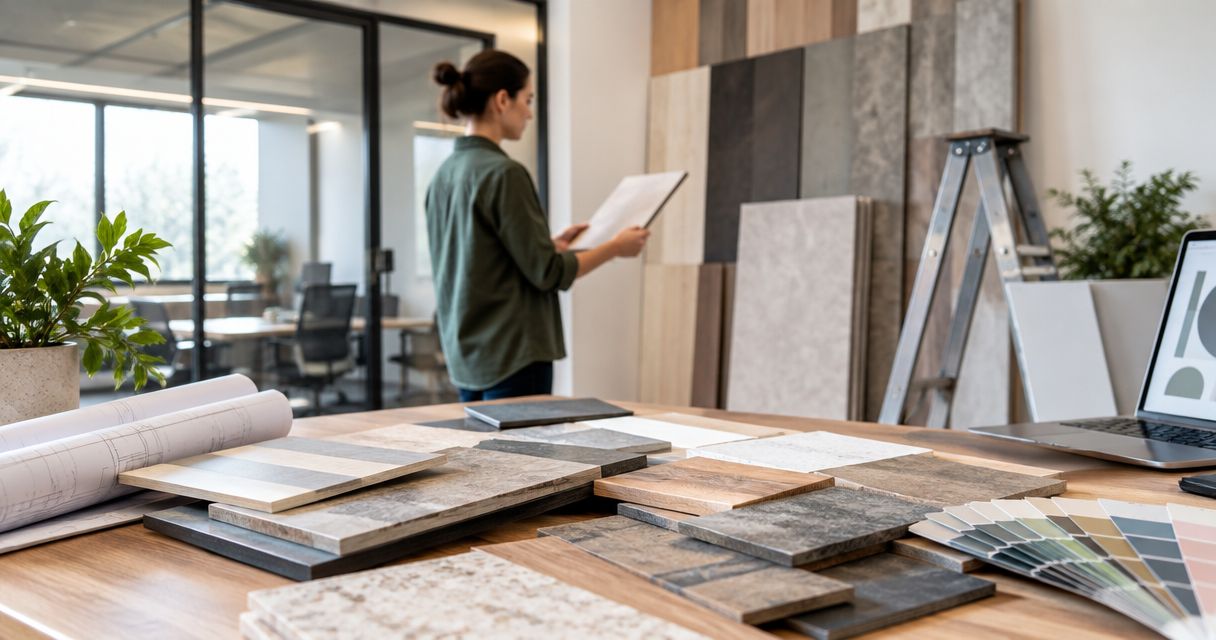
Best overall for resistance to surface wear: porcelain tile. Best for refinishing: terrazzo. Best for local replacement: carpet tiles. This Giant Leap guide to office renovation materials ranked by durability 2026 focuses on flooring, where foot traffic, chair movement, grit and cleaning create different durability demands.
TL;DR
- Office renovation materials ranked by durability 2026: porcelain tile leads this flooring-focused shortlist for surface wear resistance.
- Terrazzo suits permanent finishes; its ability to be refinished matters more than scratch resistance alone.
- Rubber flooring suits movement-heavy spaces, while luxury vinyl tile needs protection from rolling loads and grit.
- Carpet tiles favour acoustic comfort and local replacement rather than resistance to spills and staining.
Why this matters
The most durable office floor is the one that withstands its actual use and can be maintained without disrupting work. A hard surface can resist abrasion yet chip under impact. A softer surface can mark more easily but allow a damaged section to be replaced.
The Giant Leap office renovation materials guide is best for office decision-makers comparing wear resistance with repairability. Use this 2026 shortlist to choose a material category, then check the proposed product, installation method and maintenance requirements before specifying it.
This ranking covers 6 flooring categories, not every component of an office renovation. Paint, worktops, partitions and upholstery need separate comparisons because their failure modes differ. A single durability league table across those applications would hide more than it explains.
What makes the best durable office flooring?
Use these 5 selection checks before comparing samples. Together, they distinguish a finish that looks hard-wearing from a floor assembly that suits daily office use.
- Surface wear: How does the proposed finish handle grit, footwear and repeated chair movement?
- Impact and loading: What happens when furniture moves, equipment rolls across joints or an object falls?
- Moisture and staining: Can the surface, seams and substrate tolerate the cleaning and spills expected in that zone?
- Repairability: Can you replace a section, renew the finish or refinish the surface without removing the whole floor?
- Maintenance fit: Can your cleaning team follow the required method consistently, including treatment of joints and protective finishes?
Ask for product-specific evidence, not a generic claim that a material is commercial grade. Slip resistance, fire performance and acoustic requirements also need separate checks; durability alone does not establish suitability.
Durable office flooring at a glance
The order below prioritises surface wear resistance, then considers repair and maintenance. It is a specification shortlist, not a claim that every product in one category outperforms every product below it.
1. Porcelain tile
- Best for: Hard-wearing circulation areas
- Standout durability feature: Hard surface that resists abrasion
- Key limitation: Brittle edges and grout require attention
2. Terrazzo
- Best for: Permanent reception finishes
- Standout durability feature: Suitable systems can be ground and refinished
- Key limitation: Cracks and repairs can remain visible
3. Polished concrete
- Best for: Retaining a suitable existing slab
- Standout durability feature: Existing concrete becomes the finished surface
- Key limitation: Slab defects become finish defects
4. Rubber flooring
- Best for: Movement-heavy support areas
- Standout durability feature: Resilient surface for repeated foot traffic
- Key limitation: Staining and indentation need product checks
5. Luxury vinyl tile
- Best for: Modular hard-surface refurbishment
- Standout durability feature: Individual units support local replacement
- Key limitation: Surface damage cannot be sanded away
6. Carpet tiles
- Best for: Quiet desk areas
- Standout durability feature: Damaged modules can be replaced
- Key limitation: Absorbent fibres need spill management
1. Porcelain tile: best durable flooring for circulation areas
Porcelain tile provides a hard wearing surface for corridors, entrances and other circulation areas. Its durability depends on more than the tile: substrate preparation, adhesive coverage, movement joints and grout all affect the finished floor.
For a 2026 office specification, compare the actual tile's intended use and slip-resistance information. A decorative wall tile is not a substitute for a floor product, and a polished surface is not automatically suitable near a wet entrance.
Porcelain tile pros:
- Resists routine surface abrasion.
- Does not need sanding to renew a protective timber-style finish.
- Individual tiles can be replaced when matching material is retained.
Porcelain tile cons:
- Sharp impacts can chip or crack tiles.
- Grout introduces joints with separate cleaning needs.
- Hard surfaces provide little cushioning underfoot.
Best for: Busy circulation routes where surface wear matters more than softness.
Verdict: Buy for hard-wearing circulation areas; skip a finish without suitable slip-performance evidence.
2. Terrazzo: best durable flooring for a permanent reception finish
Terrazzo combines aggregate with a binder to form a finished surface. Cement-based and resin-based systems have different properties, so specify the system rather than treating terrazzo as one interchangeable material.
Its strongest durability argument is renewability: suitable terrazzo floors can be ground and refinished. That does not make them crack-proof. Substrate movement, joint design, cleaning chemistry and the chosen binder still matter.
Terrazzo pros:
- Suitable systems allow surface refinishing.
- Provides a continuous visual finish between planned joints.
- Supports a long-term maintenance approach rather than routine covering replacement.
Terrazzo cons:
- Cracks can remain visually prominent.
- Repairs need skill to match aggregate and colour.
- The binder determines important chemical and staining limitations.
Best for: Reception areas intended to retain a permanent finish through future furniture changes.
Verdict: Buy when long-term refinishing is part of the maintenance plan; hold until the substrate and system are confirmed.
3. Polished concrete: best durable flooring for a suitable existing slab
Polished concrete uses the concrete slab itself as the finished floor rather than covering it with another material. Grinding and polishing expose the slab's aggregate and existing character, including variations that a covering would conceal.
The slab is the deciding factor. Cracks, patching, construction joints and contamination cannot be assumed to disappear during polishing. Review a representative trial area before accepting the finish across the office.
Polished concrete pros:
- Removes a separate floor-covering layer from the assembly.
- Allows suitable surfaces to be repolished.
- Avoids damage to a thin decorative wear layer.
Polished concrete cons:
- Existing cracks and repairs remain part of the appearance.
- Acidic spills can damage cement-based surfaces.
- A hard, reflective room needs separate acoustic planning.
Best for: Offices with an existing slab whose condition and appearance suit exposure.
Verdict: Buy only after inspecting a trial area; skip if the desired result depends on hiding slab defects.
4. Rubber flooring: best durable flooring for movement-heavy areas
Rubber flooring provides a resilient surface rather than the rigid finish of tile or concrete. It suits a shortlist for support spaces where repeated movement and underfoot comfort both matter.
Check the proposed rubber product against actual equipment and cleaning chemicals. Rubber formulations differ, and resistance to a rolling trolley does not establish resistance to every oil, solvent or concentrated load.
Rubber flooring pros:
- Provides resilience underfoot.
- Avoids the brittle edge damage associated with ceramic materials.
- Offers sheet or tile formats, depending on the product.
Rubber flooring cons:
- Concentrated loads can leave indentations.
- Some substances cause staining or discolouration.
- Cleaning requirements vary by formulation and surface treatment.
Best for: Movement-heavy support areas where a resilient finish is preferable to a rigid one.
Verdict: Buy after checking load and chemical compatibility; hold if equipment requirements are undefined.
5. Luxury vinyl tile: best durable flooring for modular refurbishment
Luxury vinyl tile, or LVT, provides a decorative resilient covering in modular pieces. Its practical advantage is local replacement, not an ability to resist every scratch or recover through sanding.
For 2026 refurbishment planning, distinguish glued installations from floating systems. Their joint behaviour, substrate requirements and repair methods differ. Select the installation system alongside the surface design, not after it.
Luxury vinyl tile pros:
- Modular units support targeted repairs.
- Provides a less rigid surface than ceramic tile.
- Allows damaged pieces to be exchanged when matching material is retained.
Luxury vinyl tile cons:
- Grit and furniture movement can scratch the surface.
- Concentrated loads can cause indentation.
- Surface damage cannot be removed by sanding and refinishing.
Best for: Refurbishments that prioritise modular replacement and a resilient hard-surface finish.
Verdict: Buy with a documented chair, load and substrate specification; skip decisions based on appearance alone.
6. Carpet tiles: best durable flooring for quiet desk areas
Carpet tiles trade resistance to wet contamination for acoustic absorption and modular repair. They belong in this comparison because a replaceable surface can remain serviceable even when individual modules suffer damage.
Judge pile construction, backing and the manufacturer's intended application together. For desk areas, also confirm castor compatibility and the cleaning response for drinks, tracked-in dirt and repeated traffic lanes.
Carpet tiles pros:
- Individual modules can be replaced.
- Absorb sound rather than reflecting it like hard flooring.
- Allow localised maintenance around occupied work areas.
Carpet tiles cons:
- Fibres retain soil and need regular cleaning.
- Spills can stain or affect the backing.
- Replacement modules can contrast with worn surrounding tiles.
Best for: Desk neighbourhoods where acoustic comfort and replaceability outweigh wet-cleaning needs.
Verdict: Buy for dry working areas with a cleaning plan; skip persistently wet zones.
Match the floor to the office zone
Do not force one material through every room. Divide your 2026 brief into 3 office zones and identify the dominant source of damage before choosing finishes.
Entrance zones
Prioritise grit control, wet footwear and safe transitions. Porcelain tile belongs on this shortlist, but the entrance matting and cleaning method are part of the specification, not accessories added after installation.
Desk zones
Prioritise chair movement, acoustics and local repairs. Carpet tiles and LVT solve different problems here: carpet absorbs sound, while LVT provides a wipeable surface. Neither removes the need to check castor suitability.
Support zones
Prioritise equipment loads, spills and cleaning access. Rubber, porcelain and other suitable finishes need to be checked against the actual room use; a storage area and a kitchenette do not impose identical demands.
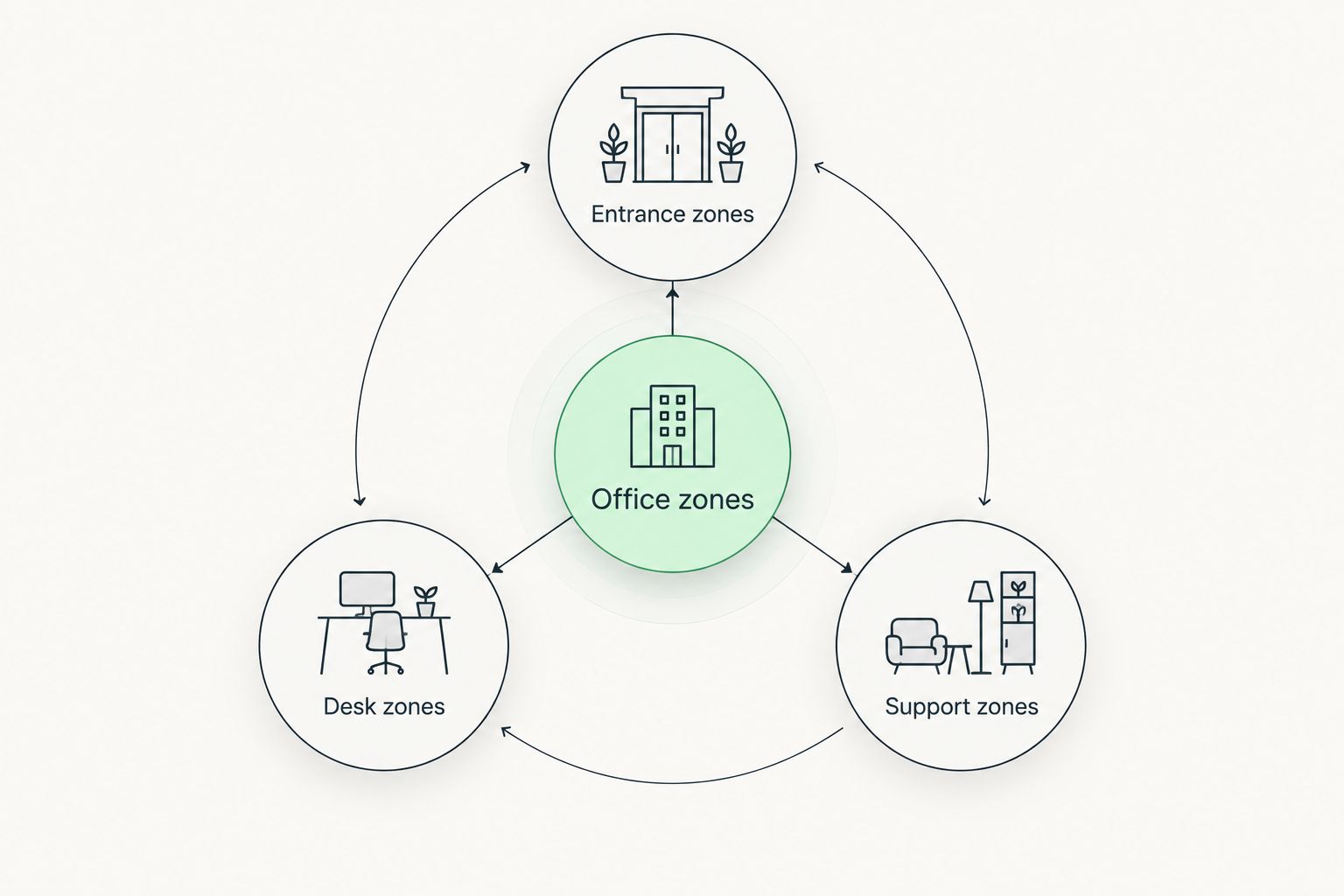
Choose flooring by the damage expected in each zone, not by a single office-wide ranking.
How the materials are ranked
This Giant Leap comparison places porcelain first for a surface-wear-led brief, then separates the remaining materials by their repair and application strengths. It is not a laboratory test or a prediction of service life.
The ranking uses the selection checks above: surface wear, impact and loading, moisture and staining, repairability, and maintenance fit. Product-level evidence can change the final choice. A suitable commercial carpet tile is a better desk-area specification than an unsuitable hard tile selected solely because it ranks higher here.
Before approval, request the proposed product's technical documentation, maintenance instructions and warranty conditions. Assess a sample with the intended lighting and retain matching repair material where the chosen system allows local replacement.
Which durable office flooring should you choose?
Choose porcelain tile as the default shortlist leader when surface wear is the main concern. Choose terrazzo when refinishing a permanent finish matters, and consider polished concrete only when the existing slab supports the intended result.
For occupied working areas, do not let hardness decide everything. Rubber addresses resilience, LVT addresses modular hard-surface replacement, and carpet tiles address acoustics and replaceability. The 2026 decision is strongest when each zone has a defined failure risk and an agreed repair method.
FAQ
What's the most durable flooring for an office renovation?
Porcelain tile leads this shortlist when resistance to surface wear is the main priority. The final specification still needs suitable slip performance, substrate preparation and joint design.
Is terrazzo more durable than porcelain tile?
Terrazzo has a refinishing advantage, while porcelain tile leads this comparison for surface wear resistance. Choose between them by comparing the actual systems and the maintenance approach.
Is polished concrete a good choice for an existing office?
Polished concrete is a good candidate when the existing slab's condition and appearance suit exposure. Inspect a trial area because cracks, patches and aggregate variation remain relevant to the finished result.
Are carpet tiles durable enough under office chairs?
Carpet tiles need product-specific confirmation for castor-chair use. Check the construction, backing, intended application and maintenance instructions rather than relying on the material category alone.
Does waterproof flooring prevent moisture problems?
A water-resistant floor surface does not establish that the complete floor assembly can tolerate moisture. Adhesives, joints, perimeter details and the substrate require separate assessment.
Should an office use the same flooring in every room?
An office should use the same flooring throughout only when it meets every room's requirements. Entrances, desk areas and support spaces impose different demands on cleaning, acoustics and loading.
How do I make office flooring last longer?
Control grit, use compatible furniture castors and follow the specified cleaning method. Keep repair material where appropriate and address damaged joints or loose sections before damage spreads.
One last thing
Ask the installer to explain how a damaged section will be repaired before approving the material. A sample shows the finish; a repair plan shows what happens after someone damages it.
Keep the product reference, installation details and maintenance instructions with your building records. A durable floor becomes harder to maintain when nobody can identify its finish or approved cleaning method.